


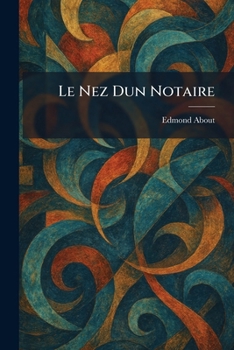
Le Nez Dun Notaire

Select Format
Select Condition 
Book Overview
"Le Nez Dun Notaire" is a celebrated satirical novel by Edmond About that explores the vanities and social anxieties of 19th-century French society. The story follows the life of Simon L'Ambert, a wealthy and superficial Parisian notary who prides himself on his physical appearance and social standing. His life takes a dramatic and absurd turn when he loses his nose in a duel over a trivial matter. In an era before modern plastic surgery, L'Ambert undergoes a pioneering and experimental procedure to restore his features, grafting skin from a humble water-carrier.
This witty and humorous work delves into the consequences of this biological connection between two men from vastly different social strata. As the health and lifestyle of the donor begin to affect the notary's new nose, About weaves a sharp critique of class distinctions, medical ethics, and the fragility of identity. Through its whimsical premise and biting irony, "Le Nez Dun Notaire" remains a significant example of French literary satire, offering a timeless reflection on the absurdities of human pride and the interconnectedness of society.
This work has been selected by scholars as being culturally important, and is part of the knowledge base of civilization as we know it. This work was reproduced from the original artifact, and remains as true to the original work as possible. Therefore, you may see the original copyright references, library stamps (as most of these works have been housed in our most important libraries around the world), and other notations in the work.
This work is in the public domain in the United States of America, and possibly other nations. Within the United States, you may freely copy and distribute this work, as no entity (individual or corporate) has a copyright on the body of the work.
As a reproduction of a historical artifact, this work may contain missing or blurred pages, poor pictures, errant marks, etc. Scholars believe, and we concur, that this work is important enough to be preserved, reproduced, and made generally available to the public. We appreciate your support of the preservation process, and thank you for being an important part of keeping this knowledge alive and relevant.
Customer Reviews
ThriftBooks ® and the ThriftBooks ® logo are registered trademarks of Thrift Books Global, LLC
