


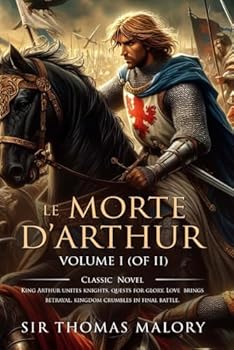
Le Morte D'Arthur, Volume I (of II): Complete with Classic illustrations and Annotation
No Customer Reviews

"Le Morte d'Arthur" penned by Sir Thomas Malory in the 15th century, stands as a seminal work in Arthurian literature, compiling and reinterpreting a vast array of tales concerning King Arthur, the Knights of the Round Table, and the quest for the Holy Grail. Malory's narrative weaves a rich tapestry of chivalry, romance, and tragedy, capturing the imagination of readers for centuries. The narrative begins with the conception and birth of Arthur, establishing his right to the throne through the legendary pulling of the sword from the stone. This event sets the stage for Arthur's reign, marked by the establishment of Camelot and the Round Table, symbols of his efforts to create a just and noble kingdom. Malory's portrayal of Arthur is that of an ideal king, embodying the virtues of bravery, wisdom, and fairness, yet he is not without his flaws, which humanize him and make his story more compelling. Central to the narrative are the exploits of Arthur's knights, particularly Sir Lancelot, Sir Gawain, Sir Tristram, and Sir Galahad. Each knight's tale is a microcosm of the chivalric ideals of the time--valor, loyalty, and courtly love. Sir Lancelot, perhaps the most famous of Arthur's knights, is portrayed as the epitome of chivalry and prowess in battle. However, his adulterous love for Queen Guinevere introduces a tragic flaw that ultimately contributes to the downfall of Camelot. This duality in Lancelot's character adds depth to the narrative, illustrating the conflict between personal desire and duty. Sir Galahad's quest for the Holy Grail represents the spiritual dimension of Malory's work. Galahad, depicted as the perfect knight, embarks on a divine mission, achieving the vision of the Grail due to his purity and piety. This quest contrasts sharply with the more earthly adventures of the other knights, highlighting the tension between secular knighthood and spiritual salvation. Malory uses the Grail quest to explore themes of faith, redemption, and the human yearning for a higher purpose. The themes of loyalty and betrayal are prevalent throughout "Le Morte d'Arthur." The fellowship of the Round Table, initially strong and united, gradually disintegrates due to internal conflicts and betrayals. The illicit love affair between Lancelot and Guinevere, along with the treachery of Mordred, Arthur's illegitimate son, catalyzes the kingdom's downfall. Malory paints a poignant picture of how personal failings and ambitions can unravel even the noblest of endeavors, reflecting the complex nature of human relationships and the fragility of idealism. Malory's prose, while reflective of the language and style of the 15th century, remains accessible and engaging. His narrative technique is straightforward, often relying on direct discourse and action to drive the story forward. Despite its archaic language, the text's rhythm and cadence possess a lyrical quality that enhances the storytelling experience. Readers may find the repetition of certain motifs and phrases both a stylistic hallmark and a reflection of the oral tradition from which many Arthurian legends originated. "Le Morte d'Arthur" is not merely a collection of heroic exploits; it is a meditation on the rise and fall of ideals. The fall of Camelot serves as a powerful allegory for the inevitable decline of all human endeavors, no matter how noble. Arthur's death, poignantly depicted by Malory, signifies the end of an era, leaving readers with a sense of melancholy and reflection on the impermanence of greatness.
Format:Paperback
Language:English
ISBN:B0D7V79N4H
ISBN13:9798329255669
Release Date:June 2024
Publisher:Independently published
Length:426 Pages
Weight:1.58 lbs.
Dimensions:9.0" x 1.1" x 6.0"
Customer Reviews
0 rating
Copyright © 2026 Thriftbooks.com
Terms of Use | Privacy Policy | Do Not Sell/Share My Personal Information | Cookie Policy | Cookie Preferences | Accessibility Statement
ThriftBooks ® and the ThriftBooks ® logo are registered trademarks of Thrift Books Global, LLC
ThriftBooks ® and the ThriftBooks ® logo are registered trademarks of Thrift Books Global, LLC
