


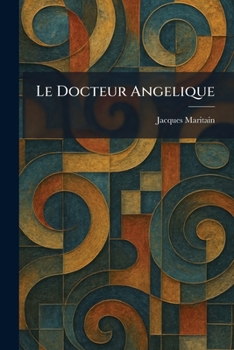
Le Docteur Angelique

"Le Docteur Angelique" is a profound exploration of the life and intellectual legacy of St. Thomas Aquinas, written by the eminent Catholic philosopher Jacques Maritain. In this work, Maritain examines the enduring relevance of Thomistic thought in the modern world, positioning Aquinas not merely as a historical figure but as a living guide for contemporary philosophical and theological inquiry. The text delves into the synthesis of faith and reason that defines the Angelic Doctor's methodology, highlighting how his rigorous logic and spiritual depth provide a stable foundation for understanding reality.
Maritain captures the essence of Aquinas's mission to harmonize Aristotelian philosophy with Christian revelation. Through a series of insightful reflections, the author argues for the necessity of returning to the principles of Scholasticism to navigate the complexities of modern existential and social challenges. This book serves as both an introduction to the thought of St. Thomas Aquinas and a passionate defense of his status as the "Universal Doctor" of the Church. Readers will find a compelling portrait of a thinker whose work continues to shape the trajectory of Western intellectual history and spiritual tradition.
This work has been selected by scholars as being culturally important, and is part of the knowledge base of civilization as we know it. This work was reproduced from the original artifact, and remains as true to the original work as possible. Therefore, you may see the original copyright references, library stamps (as most of these works have been housed in our most important libraries around the world), and other notations in the work.
This work is in the public domain in the United States of America, and possibly other nations. Within the United States, you may freely copy and distribute this work, as no entity (individual or corporate) has a copyright on the body of the work.
As a reproduction of a historical artifact, this work may contain missing or blurred pages, poor pictures, errant marks, etc. Scholars believe, and we concur, that this work is important enough to be preserved, reproduced, and made generally available to the public. We appreciate your support of the preservation process, and thank you for being an important part of keeping this knowledge alive and relevant.
Customer Reviews
ThriftBooks ® and the ThriftBooks ® logo are registered trademarks of Thrift Books Global, LLC
