


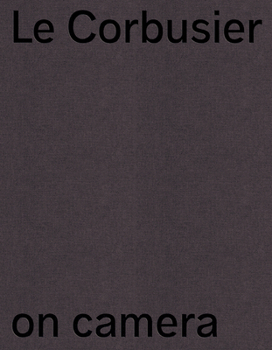
Le Corbusier on Camera: The Unknown Films of Ernest Weissmann

For the first time, still images of groundbreaking Swiss-French
architect, Le Corbusier, and others, filmed by fellow architect, Ernest
Weissmann.
The book is based on amateur films, shot by the architect Ernest Weissmann (1903-1985) with a Path Motocamera in the years 1929-1933 at the Atelier Le Corbusier and Pierre Jeanneret, among others. These films have never been published before and capture moments from Le Corbusier's life that have never been seen before. It also documents his friendships with Pierre Jeanneret, Josep Llu s Sert, Charlotte Perriand, Norman Rice, Kunio Maekawa, Sigfried Giedion and others. In six chapters, the book shows impressive stills of these films and places them in the respective historical and personal context of Le Corbusier in introductory texts.
Two introductions are devoted to the history of these films and Ernest Weissmann's life and his life-long relationship with Le Corbusier.
A documentary treasure trove on the life of Le Corbusier - Featuring 80 previously unpublished film stills - Available as softcover (9783035627282), hardcover
(9783035627299) and limited special edition with three photographic prints
(9783035627305)
Le Corbusier (1887-1965) is considered one of the most famous
visionary architects and urban designers of the 20th century. With his
cousin, he ran the Atelier Le Corbusier and Pierre Jeanneret from 1922
until 1940. During this period, most of the practice's modernist villas
were built, and bigger works such as the Centrosoyus in Moscow, and the
Cit de Refuge and the Pavillon Suisse in Paris, realized. In parallel,
Le Corbusier developed urban-design projects for such cities as Paris,
Antwerp, Algiers, and Buenos Aires, and wrote extensively on his
architectural and urbanistic ideas. He continued the Atelier Le
Corbusier on an individual base from 1940 on, with projects such as the
Unit s d'Habitation in Marseilles and in Nantes-Rez , Briey, Firminy,
and Berlin; the Monastery of Sainte-Marie de La Tourette; and the church
of Notre-Dame du Haut Ronchamp. He designed the new state capital of
the north Indian states of Punjab and Haryana, Chandigarh, with its
representative buildings, from 1951 on.
(1903-1985) was a Croatian (then-Yugoslav) architect and
developer/planner. He graduated in architecture in Zagreb, and worked
for Adolf Loos and Le Corbusier and Pierre Jeanneret in Paris. He
dedicated his work to the development of the prefabricated
hospital-building type and city planning viewed from social and economic
points of view. He was an active member of the Congr s Internationaux
d'Architecture Moderne (CIAM) from 1929 until 1947. From 1942 until
1966, he worked for the United States Board of Economic Warfare and
United Nations Relief and Rehabilitation Administration, Economic
Commission, and Department of Economic and Social Affairs. At the UN,
Weissmann was in charge of housing, building, and planning at a global
scale. Special edition
- Swiss Hardcover, linen
- three special prints of film stills in a pochette
- limited edition, hand numbered
- color-coordinated threads on the spine (according to Le Corbusier's color palette of 1930)
- books wrapped in glassine
Related Subjects
ArchitectureCustomer Reviews
ThriftBooks ® and the ThriftBooks ® logo are registered trademarks of Thrift Books Global, LLC
