


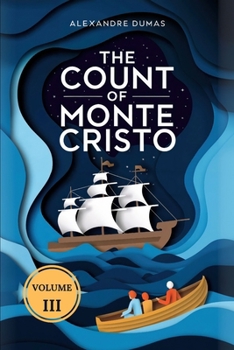
The Count of Monte Cristo (Volume 3): A New Translation
(Part of the Le Comte de Monte-Cristo Series)

Select Format
Select Condition 
Book Overview
February 1815. Edmond Dant s is nineteen, a sailor on the verge of his first captaincy, about to marry the woman he loves. Three men, for three separate reasons - jealousy, professional envy, and political self-interest - converge their denunciations on the same innocent target. He is taken to the Ch teau d'If, the island fortress in the Bay of Marseille, and the gate closes behind him.
He will not emerge as Edmond Dant s.
In the years of his imprisonment, a wrongly tunneled escape attempt introduces him to the Abb Faria - an old man, another political prisoner, who will spend thirteen years teaching him mathematics, science, history, philosophy, and five languages, and who will die leaving him the location of a treasure on an island called Monte Cristo and the intellectual formation to make use of it. What Faria bequeaths Dant s is not only wealth. It is the capacity to become anyone.
Alexandre Dumas and his collaborator Auguste Maquet serialized The Count of Monte Cristo in the Journal des D bats from 1844 to 1846, drawing on a documented case of false imprisonment and elaborate revenge that they transformed into something of entirely different scale and ambition: a novel in which the myth of justice denied and justice reclaimed is embedded in the specific history of Napoleonic France, organized around one of the most intricate plots in European fiction, and driven toward a philosophical conclusion darker and more searching than the word "revenge" suggests.
The Count arrives in Paris with unlimited wealth, an impenetrable identity, and a plan so precisely constructed that the three men who destroyed Edmond Dant s will destroy themselves. What he cannot control - what the plan's own success reveals - is how far the destruction spreads, how many people who had no part in the original crime stand in the path of a mechanism designed for justice and operating with the indifference of a force too large for its target. The recognition that even the most justified revenge cannot be administered with the precision that justice requires is what the Count of Monte Cristo, in the end, costs Edmond Dant s.
One of the greatest novels ever written - and one of the most honest about what vengeance, perfectly executed, actually produces.
Customer Reviews
ThriftBooks® and the ThriftBooks® logo are registered trademarks of Thrift Books Global, LLC
