


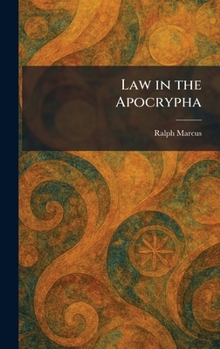
Law in the Apocrypha

"Law in the Apocrypha" is an insightful scholarly examination of the legal concepts, ethical precepts, and judicial frameworks found within the intertestamental literature of the Jewish tradition. This work explores how the diverse books of the Apocrypha reflect the evolving relationship between divine law and human governance during a pivotal period of religious and cultural history. The text meticulously analyzes the intersection of Hellenistic influences and traditional Jewish jurisprudence, providing a window into the development of early halakhic thought and moral instruction.
The study investigates various aspects of social and religious life-from civil regulations to ritual requirements-as they are depicted in seminal works such as Tobit, Judith, and the books of the Maccabees. By situating these writings within their specific historical contexts, the work highlights the continuity and transformation of legal themes from the Hebrew Bible through to the rabbinic era. "Law in the Apocrypha" serves as an essential resource for students of biblical studies, legal history, and Jewish philosophy, offering a profound understanding of the legal concerns that shaped the Jewish community in the centuries preceding the Common Era. Its rigorous analysis makes it a significant contribution to the study of the Second Temple period.
This work has been selected by scholars as being culturally important, and is part of the knowledge base of civilization as we know it. This work was reproduced from the original artifact, and remains as true to the original work as possible. Therefore, you may see the original copyright references, library stamps (as most of these works have been housed in our most important libraries around the world), and other notations in the work.
This work is in the public domain in the United States of America, and possibly other nations. Within the United States, you may freely copy and distribute this work, as no entity (individual or corporate) has a copyright on the body of the work.
As a reproduction of a historical artifact, this work may contain missing or blurred pages, poor pictures, errant marks, etc. Scholars believe, and we concur, that this work is important enough to be preserved, reproduced, and made generally available to the public. We appreciate your support of the preservation process, and thank you for being an important part of keeping this knowledge alive and relevant.
Customer Reviews
ThriftBooks ® and the ThriftBooks ® logo are registered trademarks of Thrift Books Global, LLC
