


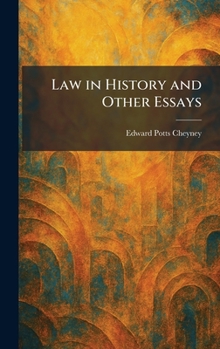
Law in History and Other Essays

"Law in History and Other Essays" is a thought-provoking collection of intellectual inquiries by the distinguished historian Edward Potts Cheyney. In this influential work, Cheyney moves beyond the mere chronicling of events to explore the underlying principles that govern the progression of human societies. The centerpiece of the collection, the title essay, presents his celebrated thesis on the existence of fundamental laws in history-patterns such as continuity, mutability, and moral progress that shape the destiny of nations.
Beyond the philosophical examination of historical mechanics, the volume includes a series of essays that delve into the methodology of the historian and the relationship between history and the social sciences. Cheyney's writing is characterized by its clarity and its commitment to understanding history as a dynamic, interconnected process rather than a series of isolated occurrences. This collection serves as an essential resource for students of historiography and readers interested in the intellectual foundations of modern historical study. By analyzing the forces of democracy and the interdependence of people, Cheyney offers a timeless reflection on how the past informs the trajectory of the future.
This work has been selected by scholars as being culturally important, and is part of the knowledge base of civilization as we know it. This work was reproduced from the original artifact, and remains as true to the original work as possible. Therefore, you may see the original copyright references, library stamps (as most of these works have been housed in our most important libraries around the world), and other notations in the work.
This work is in the public domain in the United States of America, and possibly other nations. Within the United States, you may freely copy and distribute this work, as no entity (individual or corporate) has a copyright on the body of the work.
As a reproduction of a historical artifact, this work may contain missing or blurred pages, poor pictures, errant marks, etc. Scholars believe, and we concur, that this work is important enough to be preserved, reproduced, and made generally available to the public. We appreciate your support of the preservation process, and thank you for being an important part of keeping this knowledge alive and relevant.
Customer Reviews
ThriftBooks ® and the ThriftBooks ® logo are registered trademarks of Thrift Books Global, LLC
