


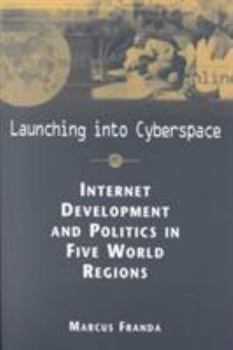
Launching into Cyberspace: Internet Development and Politics in Five World Regions (Ipolitics: Global Challenges in the Information Age)

Launching into Cyberspace explores the Internet as an increasingly important variable in the study of comparative politics and international relations in diverse national settings. Focusing on Africa,... This description may be from another edition of this product.
Format:Paperback
Language:English
ISBN:1588260372
ISBN13:9781588260376
Release Date:January 2001
Publisher:Lynne Rienner Pub
Length:280 Pages
Weight:4.40 lbs.
Dimensions:8.8" x 0.8" x 6.0"
Customer Reviews
1 rating
Topnotch "high journalism" study of a key 21st century issue
Published by Thriftbooks.com User , 22 years ago
Dr. Marcus Franda's books have long been one of international journalism's best-kept secrets: top journalists often read and consult them, since they deal with serious issues and thoughtful concepts written in a clear journalistic style versus a more ponderous academic style. One scholar likened his style to "high journalism." His books are crammed with important, painstakingly footnoted and painstakingly accurate research (quite an oddity these days when some print and broadcast journalists seem more akin to editorial writers, creative writing students or highly imaginative novelists). And he wraps up all his research, statistics, and quotes with thought-provoking concepts. Basically, Franda's books combine serious journalism with solid academic research. In Internet Development and Politics in Five World Regions, he tackles one of the 21st century's biggest potential themes with his usual thoroughness and crystal-clarity. And, as usual, an incredible amount of vital information is packed into a relatively short space (some 243 pages). This book has too many fascinating conclusions to go into here. But Franda notes that "the twin inventions" of the Internet and World Wide Web more than anything else "seem destined to spread the information revolution throughout the world." Yet, for "most people and countries of the world, becoming a significant player in the information technology revolution remains far in the future." In fact, he writes,131 countries in 1999 had less than 0.1 percent Internet connections. The bulk of his book focuses on places where Internet related technology "has been less advanced" and has run into resistance from "cultures, nondemocratic governments andpoorer societies that do not view it in the same way Western nations do." Meanwhile, he writes, the "better-off...worse-off" gap between nations has widened as new income, international diplomatic and political power sources are created. Chapters cover topics such as aspects of African cyberspace; Internet Cultures in Israel and the Arab World; the Middle East and the Global Internet Regime (including a section on Islamic and Arab Nationalist websites); Information Technology and Political Cultures in Eurasia; The Internet's political economy in Eastern Europe; Internet Politics in the former Soviet Union and other Central/Eastern European States; plus a fascinating chapter on China and India (Franda has been a longtime expert on India) as potential Internet Superpowers. Then he ties it all together with The Internet in Comparative International Perspective. One final note: I was so impressed with this book that I'm gifting it to my nephew, who is in college majoring in computer/Internet studies. And I'll soon reading two otherbooks Dr. Franda has written on related issues. This book is recommended to anyone who wants to understand the Internet's impact, potential impact, and to students, business leaders and governments who seek an overview of what
Copyright © 2026 Thriftbooks.com
Terms of Use | Privacy Policy | Do Not Sell/Share My Personal Information | Cookie Policy | Cookie Preferences | Accessibility Statement
ThriftBooks ® and the ThriftBooks ® logo are registered trademarks of Thrift Books Global, LLC
ThriftBooks ® and the ThriftBooks ® logo are registered trademarks of Thrift Books Global, LLC
