


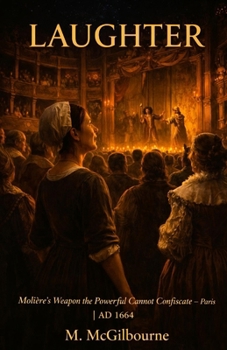
Laughter: Molière Weapon the Powerful Cannot Confiscate Paris AD 1664

This book takes you to one of the most electrifying moments in that story.
Paris, France. 1664 CE
A playwright writes a comedy about a holy man who is not holy.The Archbishop of Paris threatens excommunication for anyone who watches it.The King laughs - then bans it anyway.For five years, the most dangerous play in France cannot be performed.The man who wrote it dies on stage, playing a hypochondriac, genuinely dying.The Church denied him a Christian burial. The King intervened. He was buried in the dark, without ceremony, in a piece of ground obtained by supplication.
The arguments about what comedy can and cannot say have never stopped.
Laughter asks what it would have meant to be inside that moment.
Not as a king. Not as an Archbishop. But as the ordinary woman - the laundress who stood in the cheap section of the Palais-Royal and watched a banned play finally performed - and laughed before she had decided to.
What does it cost an ordinary person to see clearly in a world organized around the performance of surfaces?What is the difference between a holy man and a man who has learned to speak holiness - when everyone around him cannot tell?Can a laugh do what an argument cannot?The facts are extraordinary enough.
Tartuffe was written in 1664, banned within days of its first performance, rewritten twice, banned twice, and finally permitted in 1669 - five years later.The Archbishop threatened excommunication not just for watching the play, but for reading it, or speaking of it favorably.Moli re wrote to the King: "To condemn a portrait of a hypocrite is not to defend holiness. It is to defend the hypocrite."The word tartuffe entered the French language as a common noun within Moli re's lifetime. It is still in the dictionary.The streets of the Left Bank smelled of river cold and bread smoke and the waste of ten thousand households sharing a city that had not yet solved the problem of where to put what it produced. A woman woke before dawn and built her fire. She had never been to the theatre. A ticket arrived on her windowsill.
They were asking the same questions we ask. They performed something that is still performing itself - in every room where power has learned to speak the language of virtue. This book is the attempt of one ordinary witness - a woman who understood things by seeing them clearly - to answer.
For homeschooling families: You are already doing the most important thing - putting the story of humanity directly into your children's hands. The Beyond His Story We Stand series was written for you. Each book takes one moment in human history and makes it lived rather than memorised, felt rather than filed away. Not a textbook. Not a syllabus. A story your child will not want to put down - and that will leave them asking the questions that no curriculum can generate for them. The questions that only wonder produces.
Laughter - part of the Beyond His Story We Stand series - a chronological journey through human history, told through the eyes of the people official history forgot to record.
The laugh cannot be arrested. It had already happened before the ban was issued. It is still happening.
Customer Reviews
ThriftBooks ® and the ThriftBooks ® logo are registered trademarks of Thrift Books Global, LLC
