
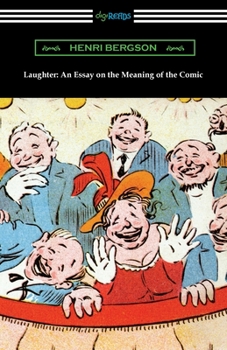
Laughter: An Essay on the Meaning of the Comic is a collection of three essays a thought-provoking exploration of the nature of humor and its role in society by French philosopher Henri Bergson. Laughter explores what it is in language that makes a joke funny and what it is in us that makes us laugh. In this influential essay, Bergson explores the nature and significance of laughter in human life. Bergson argues that laughter is a uniquely human phenomenon and seeks to uncover its underlying causes and social functions. He posits that laughter serves a social purpose, acting as a corrective mechanism for individuals who deviate from societal norms, thereby promoting social cohesion.
Early, provocative, but slight work on the subject.
Published by Thriftbooks.com User , 19 years ago
One of the more accessible books by an underrated philosopher whose usefulness, especially with regard to literary narrative, is being rediscovered, "Laughter" must qualify as one of Bergson's slighter works. Much of its importance stems from its place among the very first essays to take seriously an elusive and slippery subject. As a result, the author's thesis that laughter derives from "the mechanical encrusted upon the living" is at once somewhat dated and limiting. A reader wishes more distinctions between "comedy" and "laughter" (since many of the most revered comedies, from Shakespeare to Keaton, no longer provoke laughter from their modern audiences). Moreover, the author's thesis, though consistent with his views of "real time" (la duree), is applied too broadly to illuminate the dark let alone grey areas of "black comedy" along with numerous sub-genres, ranging from witty and garrulous, so-called "screw-ball comedy" to parody and the mock-heroic (both of the latter presenting major obstacles to appreciation let alone laughter because of what the post-modernists call "cultural amnesia"). Nevertheless, it's a readable start.
Admirable
Published by Thriftbooks.com User , 20 years ago
The blessed healing of laughter and of those who are gifted in bringing it to us. A great read for anyone who wants to live and look at the lighter side of life.
A bit dated. Somewhat incomplete. Astoundingly insightful
Published by Thriftbooks.com User , 21 years ago
Before reading this essay, you should be forewarned that it was written by the same great opponent of Cartesian dualism that resisted the reduction of psychological phenomena to physical states. In other words, this is an early 20th century French philosophical essay. To go further, it's a bit dry. Still, it is hard to argue with many of the axioms that Bergson espouses in this essay. For the most part, the laughter caused by much of modern comedy can be explained using one of his primary axioms or their many corollaries. Bergson's biggest miss here, however, is that although he adequately explains why a comic may cause an individual to laugh at either the comic himself or a third party, he doesn't sufficiently explain, or even realize, that much of what the comic intends is for his audience to laugh at themselves. Even so, you can still ascribe Bergson's incisive deductions to include the comic audience and still come to the heart of why people laugh. In any event, to my knowledge the subject has never been tackled so logically. Certainly, no (funny) comedian will ever attempt to publicly disclose the nature of laughter, but don't suppose that there aren't many famous comedians out there today who are familiar with this essay. It is obvious that many comedians and writers are familiar with this essay and that they have put these axioms directly to the test to great comic effect on many occasions. A word of advice to anyone who has difficulty wading through the chapters of Bergson's dry, recondite language: Read it in your head with the voice of baby Stewie from the Family Guy in mind. This technique amused me through the first half of the book, and by that time the language didn't bother me so much anymore.
Still profound after all these years
Published by Thriftbooks.com User , 23 years ago
Why is a pun amusing? In brief, it treats something human as if it were something mechanical. Language is a way of conveying meanings from one human to another, and the most inflexible, most mechanical, most artifiial POSSIBLE way of looking at words is to classify them by their sound alone. That's precisely what a pun does. When Mel Brooks is playing a Polish actor playing Hitler, he says: "All I want is peace. A little piece of Poland, a tiny piece of France...." That is amusing -- the juxtaposition of the vital and the mechanical. More sophisticated jokes than such puns are based on the same juxtaposition. Here is one of Bergson's example, from a play by Labiche. "Just as M. Perrichon is getting into the railway carriage, he makes certain of not forgetting any of his parcels: 'Four, five, six, my wife seven, my daughter eight, and myself nine.'"
Enormously provocative
Published by Thriftbooks.com User , 25 years ago
Yes, it is true: Nietzsche's The Birth of Tragedy is funnier than this analysis of laughter. But they are equally provocative. Bergson's thesis may not suit all of us, but it must challenge even those of us involved in the comedic professions to re-examine why people laugh. I think his observation of what makes something funny as opposed to tragic - the elimination of emotion - is pretty spot on. How else could we laugh at someone falling down the stairs? The moment we think of the actual pain or humiliation, the comedy dies at least a little. While the book does not directly attack the magic of those beings, clowns and tricksters, who simulataneaously inspire laughter and sadness and/or fear, the principles of the book lead to what sorts of rules these people follow. If you can extraploate from the thought laid out here, many, many questions will be answered and perhaps even more raised. Which makes this an indispensible book for anyone in the performing arts. Highly, highly recommended.
ThriftBooks sells millions of used books at the lowest everyday prices. We personally assess every book's quality and offer rare, out-of-print treasures. We deliver the joy of reading in recyclable packaging with free standard shipping on US orders over $20. ThriftBooks.com. Read more. Spend less.

