


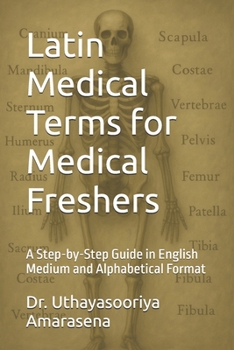
Latin Medical Terms for Medical Freshers: A Step-by-Step Guide in English Medium and Alphabetical Format
No Customer Reviews

Preface
0.1.1 Purpose of the Guidebook
Medical terminology, particularly Latin-based terms, can feel overwhelming to freshers entering the field. Yet, mastering these words is not just about memorization-it is about understanding the deep-rooted language of medicine, ensuring clarity in communication, accuracy in diagnosis, and confidence in practice. This guide serves as a structured, step-by-step resource to decode Latin medical terms in a logical, accessible, and practical manner.
0.1.2 Target Audience: Freshers in Medicine
This book is tailored specifically for medical freshers-students, interns, and aspiring professionals stepping into the rigorous world of medicine. Whether encountering Latin in textbooks, clinical discussions, or medical examinations, this guide will provide the foundation needed to navigate complex terminology with ease.
0.1.3 How This Book is Organized
The book is structured for intuitive learning, starting with the fundamental building blocks of Latin in medicine-roots, prefixes, and suffixes-before progressing to body systems, diagnostic language, and practical applications. Chapters are arranged alphabetically and thematically, ensuring ease of reference and efficient study. Additionally, exercises and mnemonics are interwoven to reinforce retention, making the learning process both systematic and engaging. Introduction to Latin in Medicine 0.2.1 Why Latin? - Historical and Practical Relevance
Latin has long been the cornerstone of medical terminology, shaping the way physicians communicate, diagnose, and treat patients. Rooted in the history of classical learning, Latin provides precision, continuity, and universal understanding in medicine-qualities that are essential in an ever-evolving field.
Historical Significance
For centuries, Latin was the language of scholars-used in scientific texts, medical manuscripts, and anatomical discoveries. Physicians from the Renaissance to modern-day practitioners have relied on Latin to ensure consistency in nomenclature across different languages and cultures. This linguistic foundation prevents misinterpretations and preserves the integrity of medical knowledge over time.
Practical Applications in Medicine
Even today, Latin remains woven into the fabric of medical practice. From anatomical descriptions to prescription writing, the use of Latin ensures clarity and standardization in global healthcare settings. Consider these key examples: Anatomical Terminology: Terms like os (bone), vena (vein), and musculus (muscle) maintain universal recognition across medical institutions worldwide.Diagnostic Terms: Latin suffixes such as -itis (inflammation), -osis (condition), and -ectomy (surgical removal) help categorize diseases and procedures with clarity.Medical Prescriptions: Latin abbreviations like q.d. (quaque die - once daily) and b.i.d. (bis in die - twice daily) ensure standardized communication between doctors and pharmacists.Examinations & Academia: Many medical entrance exams and professional assessments incorporate Latin-based terminology, making its understanding crucial for freshers in medicine.Embracing Latin is not merely an academic exercise-it is a practical tool for mastering medical communication, fostering precision in diagnosis, and strengthening the professional lexicon of future doctors.
0.1.1 Purpose of the Guidebook
Medical terminology, particularly Latin-based terms, can feel overwhelming to freshers entering the field. Yet, mastering these words is not just about memorization-it is about understanding the deep-rooted language of medicine, ensuring clarity in communication, accuracy in diagnosis, and confidence in practice. This guide serves as a structured, step-by-step resource to decode Latin medical terms in a logical, accessible, and practical manner.
0.1.2 Target Audience: Freshers in Medicine
This book is tailored specifically for medical freshers-students, interns, and aspiring professionals stepping into the rigorous world of medicine. Whether encountering Latin in textbooks, clinical discussions, or medical examinations, this guide will provide the foundation needed to navigate complex terminology with ease.
0.1.3 How This Book is Organized
The book is structured for intuitive learning, starting with the fundamental building blocks of Latin in medicine-roots, prefixes, and suffixes-before progressing to body systems, diagnostic language, and practical applications. Chapters are arranged alphabetically and thematically, ensuring ease of reference and efficient study. Additionally, exercises and mnemonics are interwoven to reinforce retention, making the learning process both systematic and engaging. Introduction to Latin in Medicine 0.2.1 Why Latin? - Historical and Practical Relevance
Latin has long been the cornerstone of medical terminology, shaping the way physicians communicate, diagnose, and treat patients. Rooted in the history of classical learning, Latin provides precision, continuity, and universal understanding in medicine-qualities that are essential in an ever-evolving field.
Historical Significance
For centuries, Latin was the language of scholars-used in scientific texts, medical manuscripts, and anatomical discoveries. Physicians from the Renaissance to modern-day practitioners have relied on Latin to ensure consistency in nomenclature across different languages and cultures. This linguistic foundation prevents misinterpretations and preserves the integrity of medical knowledge over time.
Practical Applications in Medicine
Even today, Latin remains woven into the fabric of medical practice. From anatomical descriptions to prescription writing, the use of Latin ensures clarity and standardization in global healthcare settings. Consider these key examples: Anatomical Terminology: Terms like os (bone), vena (vein), and musculus (muscle) maintain universal recognition across medical institutions worldwide.Diagnostic Terms: Latin suffixes such as -itis (inflammation), -osis (condition), and -ectomy (surgical removal) help categorize diseases and procedures with clarity.Medical Prescriptions: Latin abbreviations like q.d. (quaque die - once daily) and b.i.d. (bis in die - twice daily) ensure standardized communication between doctors and pharmacists.Examinations & Academia: Many medical entrance exams and professional assessments incorporate Latin-based terminology, making its understanding crucial for freshers in medicine.Embracing Latin is not merely an academic exercise-it is a practical tool for mastering medical communication, fostering precision in diagnosis, and strengthening the professional lexicon of future doctors.
Format:Paperback
Language:English
ISBN:B0F8P4PJ2H
ISBN13:9798283758183
Release Date:May 2025
Publisher:Independently Published
Length:200 Pages
Weight:0.60 lbs.
Dimensions:0.4" x 6.0" x 9.0"
Customer Reviews
0 rating
Copyright © 2026 Thriftbooks.com Terms of Use
| Privacy Policy | Do Not
Sell/Share My Personal Information | Cookie Policy | Cookie Preferences | Accessibility Statement
ThriftBooks® and the ThriftBooks® logo are registered trademarks of Thrift Books Global, LLC
ThriftBooks® and the ThriftBooks® logo are registered trademarks of Thrift Books Global, LLC
