


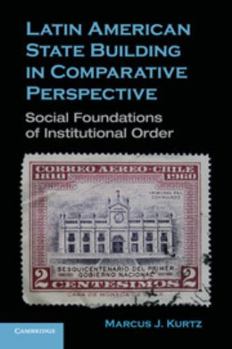
Latin American State Building in Comparative Perspective
No Customer Reviews

Select Format
Select Condition 
Book Overview
Latin American State Building in Comparative Perspective provides an account of long-run institutional development in Latin America that emphasizes the social and political foundations of state-building processes. The study argues that societal dynamics have path-dependent consequences at two critical points: the initial consolidation of national institutions in the wake of independence, and at the time when the 'social question' of mass political incorporation forced its way into the national political agenda across the region during the Great Depression. Dynamics set into motion at these points in time have produced widely varying and stable distributions of state capacity in the region. Marcus J. Kurtz tests this argument using structured comparisons of the post-independence political development of Chile, Peru, Argentina and Uruguay.
Format:Paperback
Language:English
ISBN:0521747317
ISBN13:9780521747318
Release Date:March 2013
Publisher:Cambridge University Press
Length:286 Pages
Weight:0.92 lbs.
Dimensions:0.8" x 6.0" x 9.0"
Customer Reviews
0 rating
Copyright © 2026 Thriftbooks.com Terms of Use
| Privacy Policy | Do Not
Sell/Share My Personal Information | Cookie Policy | Cookie Preferences | Accessibility Statement
ThriftBooks® and the ThriftBooks® logo are registered trademarks of Thrift Books Global, LLC
ThriftBooks® and the ThriftBooks® logo are registered trademarks of Thrift Books Global, LLC
