


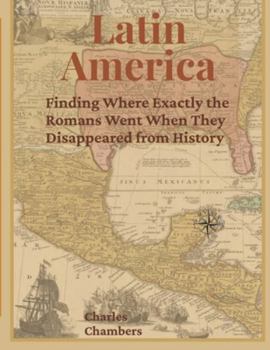
Latin America: Finding Where Exactly the Romans Went When They Disappeared from History

Certain early maps of the Americas refuse to agree with the official story of history.
Long before Spanish settlement patterns make sense, vast regions of the New World appear labeled in precise Latin administrative terms - provinces, cities, and geographic features named as if Rome never vanished at all.
Latin America is not a book of speculation or myth. It is a forensic investigation into historical anomalies that modern narratives quietly ignore:
- Why entire regions of western Mexico appear on early maps as Nova Hispania et Nova Galicia, governed in Latin rather than Spanish
- Why cities are labeled Purificatio, Compostela, and other grammatically precise Latin names
- Why indigenous place names survive only at the local level, while Latin governs the administrative layer
- Why cartography preserves memories that written chronicles later erase
Written from the Atlantic edge of Europe in Mux a, Spain - a site long associated with Roman, Celtic, and pilgrimage routes - this book follows the evidence outward across the ocean, tracing a pattern of continuity rather than collapse.
The question is not whether Rome fell.
The question is why its maps suggest it withdrew.
This book does not ask you to believe. It asks you to look.
Related Subjects
HistoryCustomer Reviews
ThriftBooks® and the ThriftBooks® logo are registered trademarks of Thrift Books Global, LLC
