


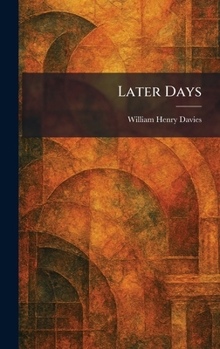
Later Days

In "Later Days", the celebrated poet and author W. H. Davies continues the fascinating life story he began in his world-renowned "The Autobiography of a Super-Tramp". Moving away from his days of wandering and homelessness, this memoir focuses on his transition into the literary circles of early 20th-century London. With his characteristic simplicity and sharp observational wit, Davies recounts his experiences with fame, his encounters with fellow literary giants such as George Bernard Shaw and Joseph Conrad, and his enduring love for the natural world.
The work offers a unique perspective on the British literary scene from an outsider who successfully navigated his way into the heart of the establishment without losing his distinct, humble voice. Davies' prose captures a period of significant cultural shift, providing intimate sketches of his contemporaries while reflecting on the challenges and joys of a writer's life. "Later Days" serves as both a compelling sequel and a standalone testament to a life lived with extraordinary curiosity and resilience, remaining a vital piece of biographical literature for those interested in the history of English letters and the personal journey of one of the century's most unique poets.
This work has been selected by scholars as being culturally important, and is part of the knowledge base of civilization as we know it. This work was reproduced from the original artifact, and remains as true to the original work as possible. Therefore, you may see the original copyright references, library stamps (as most of these works have been housed in our most important libraries around the world), and other notations in the work.
This work is in the public domain in the United States of America, and possibly other nations. Within the United States, you may freely copy and distribute this work, as no entity (individual or corporate) has a copyright on the body of the work.
As a reproduction of a historical artifact, this work may contain missing or blurred pages, poor pictures, errant marks, etc. Scholars believe, and we concur, that this work is important enough to be preserved, reproduced, and made generally available to the public. We appreciate your support of the preservation process, and thank you for being an important part of keeping this knowledge alive and relevant.
Customer Reviews
ThriftBooks ® and the ThriftBooks ® logo are registered trademarks of Thrift Books Global, LLC
