


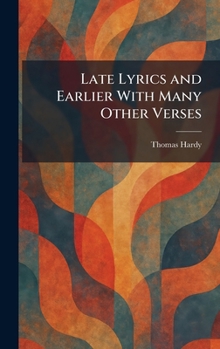
Late Lyrics and Earlier With Many Other Verses

"Late Lyrics and Earlier With Many Other Verses" is a major collection of poetry by the esteemed English author Thomas Hardy. Compiling over one hundred pieces, this volume represents the culmination of Hardy's lifelong engagement with verse, featuring both new compositions and previously unpublished earlier works. The collection is famously preceded by a substantial "Apology," a prefatory essay where Hardy reflects on the state of English poetry and responds to critics of his perceived pessimism, arguing instead for a rigorous and honest appraisal of the human condition.
The poems themselves traverse a diverse emotional and thematic landscape, ranging from the melancholy beauty of the Wessex countryside to philosophical inquiries into fate, memory, and the inevitable flow of time. Hardy's technical skill is evident in the varied meters and structures he employs, capturing the nuances of rural life and the quiet tragedies of existence. From intimate character sketches to grander meditations on the cosmos, this work highlights Hardy's transition from Victorian tradition to Modernist sensibilities. "Late Lyrics and Earlier With Many Other Verses" remains an essential reading for those seeking to understand the depth and complexity of one of literature's most enduring voices.
This work has been selected by scholars as being culturally important, and is part of the knowledge base of civilization as we know it. This work was reproduced from the original artifact, and remains as true to the original work as possible. Therefore, you may see the original copyright references, library stamps (as most of these works have been housed in our most important libraries around the world), and other notations in the work.
This work is in the public domain in the United States of America, and possibly other nations. Within the United States, you may freely copy and distribute this work, as no entity (individual or corporate) has a copyright on the body of the work.
As a reproduction of a historical artifact, this work may contain missing or blurred pages, poor pictures, errant marks, etc. Scholars believe, and we concur, that this work is important enough to be preserved, reproduced, and made generally available to the public. We appreciate your support of the preservation process, and thank you for being an important part of keeping this knowledge alive and relevant.
Customer Reviews
ThriftBooks ® and the ThriftBooks ® logo are registered trademarks of Thrift Books Global, LLC
