


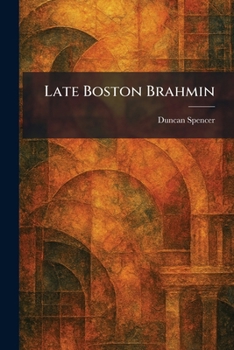
Late Boston Brahmin

Select Format
Select Condition 
Book Overview
"Late Boston Brahmin" provides a compelling exploration of the exclusive social strata that defined the cultural and intellectual life of Massachusetts. Authored by Duncan Spencer, this work examines the traditions, lineage, and evolving influence of the Boston Brahmin class during the early twentieth century. The text delves into the inner workings of these established families, detailing the codes of conduct and the weight of legacy that shaped their identity within American society.
As a significant study of social history, the book captures a pivotal moment when the traditional aristocracy of New England faced the shifting tides of a modernizing world. Spencer offers an observant and nuanced look at the individuals who navigated the tension between their ancestral heritage and the new realities of the 1920s. "Late Boston Brahmin" is an essential read for those interested in the sociology of the American upper class, the history of Boston, and the portrait of a distinct social caste at the height of its storied existence.
This work has been selected by scholars as being culturally important, and is part of the knowledge base of civilization as we know it. This work was reproduced from the original artifact, and remains as true to the original work as possible. Therefore, you may see the original copyright references, library stamps (as most of these works have been housed in our most important libraries around the world), and other notations in the work.
This work is in the public domain in the United States of America, and possibly other nations. Within the United States, you may freely copy and distribute this work, as no entity (individual or corporate) has a copyright on the body of the work.
As a reproduction of a historical artifact, this work may contain missing or blurred pages, poor pictures, errant marks, etc. Scholars believe, and we concur, that this work is important enough to be preserved, reproduced, and made generally available to the public. We appreciate your support of the preservation process, and thank you for being an important part of keeping this knowledge alive and relevant.
Customer Reviews
ThriftBooks ® and the ThriftBooks ® logo are registered trademarks of Thrift Books Global, LLC
