


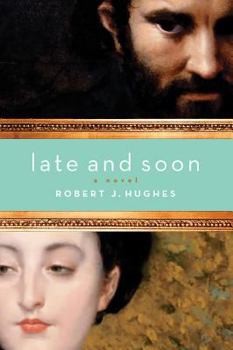
Late and Soon: a Novel


Select Format
Select Condition 
Book Overview
In Late and Soon, a host of characters confront their confusions in love. Claire, an art specialist at Sotheby's, lives in a world of glamour and achievement ? but after she runs into Toby, the young man her husband left her for five years earlier, she realizes that her broken heart never truly healed. Claire begins to question herself, her past and her future after she learns her ex-husband has also left Toby. Late and Soon chronicles Claire's emotional course, as she puts together a sale of paintings that could make her career. She is captivated by one painting in particular that speaks to her and is taken under wing by the painting's owner, an elderly, well-to-do society matron of the old school, who's parting with the painting for reasons that Claire finds poignant ? especially regarding her own romantic longings. And the possibility of romance does indeed loom. As Claire puts together her auction, she must decide whether or not to begin a relationship with Frank, her ex-husband's brother, who has come to New York in pursuit of her for so many years.
Format:Paperback
Language:English
ISBN:0786718005
ISBN13:9780786718009
Release Date:September 2006
Publisher:Da Capo Press
Length:328 Pages
Weight:0.85 lbs.
Dimensions:7.8" x 0.8" x 5.3"
Related Subjects
Contemporary Fiction Literary Literature & Fiction Psychological Thrillers ThrillersCustomer Reviews
5 ratings
A great read - multilayered prose - compelling characters
Published by Thriftbooks.com User , 19 years ago
The kind of book you savor reading in the living room over the course of a week, rather than the kind you take on the subway or read at the beach -- the characters are at times fascinating, at times dreadful, at times pitiful, but always entertaining and contain difficult truths that we observe about others and often think to ourselves. The prose is multilayered, and rewarding, putting one in mind of the novels of Henry James and Anthony Trolloppe. Highly recommended (but not on the subway).
Art, introspection and edgy romance in rich prose
Published by Thriftbooks.com User , 19 years ago
Hughes' elegant, Jamesian prose is perfect for the rarefied art world and deep introspection of his first novel. A Wall Street Journal reporter who covers the art auction market, Hughes centers his story around Claire, a 32-year-old 19th-century-art specialist at Sotheby's in New York. From Claire the third-person narrative shifts among several others: her ex-husband Peter; Toby, the man Peter left her for five years earlier, and Frank, Peter's edgy brother, a former priest. All, except Frank, are involved in the commerce of art. Toby is a video curator; Peter an antique-furniture dealer. Claire is putting together a sale of 19th century paintings, which could make her career. As the novel begins, she runs into Toby at a museum exhibit opening. Peter has left him for another man, a police detective, and Toby has sought her out for some kind of solace. "She waited for him to speak. She would not sympathize with his humiliation, having suffered her own, even if only indirectly through him way back when." But over the years she has become friendly with Toby. "He'd sought her advice, he'd shown her kindness. The kindness of the vanquisher, but still." Clearly, Claire still harbors little barbs of resentment, and unhappy Toby finally realizes she can, or will, be no comfort to him. But his distress has unsettled Claire, making her more aware of her own remoteness and social stagnation. She was often sought out as a confidante but "she was a confidante who had so little actual regard, she thought, for the essential humanness of those who chose her for verbal intimacies. She didn't know if her demeanor - a kind of hesitant acceptance of the suggestive other - led people to sense demureness that suggested depth of feeling." In passages like these Claire seems almost ruthlessly self-aware, but Hughes does not let it sink into self-loathing. The shock of her husband's homosexuality had dealt a blow to self-confidence already undermined by an indifferent mother, but Claire loves her work and enjoys an innate confidence in her abilities. Still, she has had no romantic relationship since the break-up of her marriage. Claire's contemplation of her social scars and reserve accompany her heartfelt work in putting together an important sale which will center around two James Tissot paintings, the best of which is called "A Widow." The painting, evocative of loss, love, memory and possibility, stirs both Claire and its elderly widowed owner deeply, forging a bond between them. Meanwhile, Frank, now a gruff, demanding and unfulfilled professor, has come to New York, ostensibly to write a book, but essentially to seek out Claire. A serious, intense, attractive man, he frightens as much as fascinates her. Frank is not a casual man and she uses her upcoming sale to keep him at arm's length while she decides what to do. Peter tries to connect with his difficult brother and build a relationship with his new lover. As the book progresses he sheds the flighty, p
highly recommended
Published by Thriftbooks.com User , 20 years ago
Just the kind of thing I like best -- interesting characters, with subtle analysis of their thoughts, motivations, development over time. It's set in the art world of New York City which makes an interesting backdrop. It would make for a great book-group discussion, so I'm going to suggest it to my book group.
A beautiful novel reminiscent of Henry James
Published by Thriftbooks.com User , 20 years ago
Robert J. Hughes has written a beautifully layered novel that reminded me of Henry James. Set in modern-day New York, it follows the lives of four richly drawn characters and their entangled love lives. Hughes has created an empathetic protagonist in Claire and the men surrounding her are equally engaging and memorable. Best of all, Hughes casts New York as an important character as well, and illuminates the city's art and opera scene with an insider's knowledge. This is definitely for fans of Henry James and Edith Wharton -- set in modern times. A must read.
"Mementoes are one thing, not changing is another"
Published by Thriftbooks.com User , 20 years ago
Love, loss, beauty, and the limits of art are the threads, which tie this gorgeously evocative novel together. The quintet of characters, the players in the New York City art world, are always on the move, never sure where they're going to end up, but forever certain that they have to reconcile the ghosts of their past. The beautiful Claire is an art specialist at Sotherby's Auction House, moving within an insular world of glamour, money, and prestige. One night at an art auction, she bumps into her ex-husband Peter, a dealer in antiques, who had left her a few years ago for Tobias, a video creator. She soon finds out that Peter recently has dumped Tobias for Sean, a NYPD detective. Seeing Peter again, unleashes in Clare a flurry of unease regarding her emotional uncertainties. She not only castes in her lot with Toby as the victim, but also begins to re-examine her own life. Up until now she has had an enormous capacity for forgiveness and has been able to sympathize, and even empathize with Peter's courage in coming out. She liked to think she felt sorrow rather than rage at Peter's treachery, "At what might have been, what she did not have." When Frank, Peter's older brother comes to New York, Claire hesitatingly reconnects with him even though when she was married to Peter, she hardly new him. Frank, for his part, has just left the priesthood and now wants to write a managerial book based on the writings of Teresa of Avila. He's convinced that her work in founding an order running a convent might apply to an entrepreneurial business world. Frank is rather bitter and cynical, having fallen into a meditative numbness, gliding further and further from a life of energy and compassion that he knew was the best, and for him, the only life worth living. He resents Peter, but feels as though he really should reach out to his brother, for they were alike in that they had both been wrong about themselves, their desires and beliefs, but it seemed that Peter was the one who had "become free." Claire, Peter, Frank, Tobias and Sean discover a gradual unfurling of hidden promises, their lives fraught with conflict and desire, the fetters of loneliness weighing upon their moods. New friendships are forged; old animosities are conquered, the disparate elements becoming integrated into a whole. The effect of memory is the thematic core of the novel- Claire's vision of Peter the past few years had been coloured through that memory, through her perception. Perhaps like Toby she'd had a nebulous unease growing within her, a dissatisfaction she couldn't name, "a phantom glimpsed in the eyes periphery." On the other hand, Peter, who feels he's been alone for the longest time, is trying is to create a family, he wants to reconnect with his brother, since the family he was born with hadn't worked out, what's left of it. Peter believed in himself so much that he was trying to do right when he seemed careless of how what he did affected others. Toby is als
Copyright © 2026 Thriftbooks.com Terms of Use
| Privacy Policy | Do Not
Sell/Share My Personal Information | Cookie Policy | Cookie Preferences | Accessibility Statement
ThriftBooks® and the ThriftBooks® logo are registered trademarks of Thrift Books Global, LLC
ThriftBooks® and the ThriftBooks® logo are registered trademarks of Thrift Books Global, LLC
