


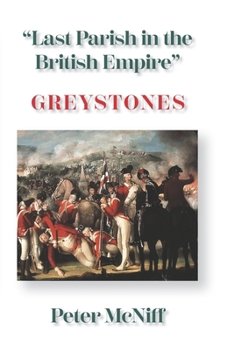
"Last Parish in the British Empire": Greystones, County Wicklow, Ireland.
No Customer Reviews

Many places in the world lay claim to being the "Last Parish in the British Empire." Greystones County Wicklow was among them until recent times. From a simple fishing harbour, it became a bastion for an elite band of middle-class Protestants. Its beginnings were more modest. A natural deepwater harbour made it a useful place to launch their boats and fish for a living. Up to four hundred people worked in the fishery at the beginning of the eighteen hundreds. But hardly a soul lived in the place.
The majority lived up in the hills in settlements, usually at the gates of their oppressors, the British, who, having confiscated the best farming land, kept them in the margins for the best part of five hundred years before Intellectuals like Wolfe Tone crystallised what people had secretly discussed and plotted for years: rebellion. Tone wanted to separate Ireland from the British Government and the right to vote to apply to Catholics and Protestants. More to the point, to avoid sectarian labelling, he wanted the vote to be given to those who could call themselves "Irish."
Ireland's Rebellion of 1798 came with a terrible loss of life ― in battles where the British artillery employed an invention ― anti-personnel shells. The author draws parallels between the Israeli-Palestinian conflict that began with the Zionist war of 1948 and that today has deteriorated into what many are calling genocide. It is worth noting that both cases ― Irish and Israeli ― carry the complications of radical opposition to each other's religious practices and political beliefs.
But the Rebellion panicked the British, who forced a Union with Ireland, ruled from Westminster, and left chaos behind. Dublin, once regarded as the fifth most beautiful city in Europe, sank into a swamp of poverty and disease where life expectancy for all classes of people was down to an average of thirty-five years, with death taking a massive toll in infancy.
Half a century later, in 1855, the railroad reached down from Dublin to Wexford, and the company built a train station and named it Delgany ― for the centre of the population more than two miles away ― and Greystones became its virtual invention.
At first, it became a summer resort for wealthy Dubliners to escape from the noise and dust of Dublin. But as ranking middle-class Protestants saw their political power swing to Nationals, they moved out of the city. They settled in the suburbs, in Rathmines and Ranelagh. With the train's arrival, they built new homes in Dun Laoghaire, Dalkey and Bray. Greystones proved a perfect place to practise their religion and lord it over the poor, who built their houses and provided all the usual convenient services.
They lived in defiance of the regime long after Ireland was declared a Free State, still flying Union Jack at the harbour flagstaff and in their parish church. Such facts make it easy to comprehend how Greystones came to be mocked for generations as the "Last Parish in the British Empire."
The majority lived up in the hills in settlements, usually at the gates of their oppressors, the British, who, having confiscated the best farming land, kept them in the margins for the best part of five hundred years before Intellectuals like Wolfe Tone crystallised what people had secretly discussed and plotted for years: rebellion. Tone wanted to separate Ireland from the British Government and the right to vote to apply to Catholics and Protestants. More to the point, to avoid sectarian labelling, he wanted the vote to be given to those who could call themselves "Irish."
Ireland's Rebellion of 1798 came with a terrible loss of life ― in battles where the British artillery employed an invention ― anti-personnel shells. The author draws parallels between the Israeli-Palestinian conflict that began with the Zionist war of 1948 and that today has deteriorated into what many are calling genocide. It is worth noting that both cases ― Irish and Israeli ― carry the complications of radical opposition to each other's religious practices and political beliefs.
But the Rebellion panicked the British, who forced a Union with Ireland, ruled from Westminster, and left chaos behind. Dublin, once regarded as the fifth most beautiful city in Europe, sank into a swamp of poverty and disease where life expectancy for all classes of people was down to an average of thirty-five years, with death taking a massive toll in infancy.
Half a century later, in 1855, the railroad reached down from Dublin to Wexford, and the company built a train station and named it Delgany ― for the centre of the population more than two miles away ― and Greystones became its virtual invention.
At first, it became a summer resort for wealthy Dubliners to escape from the noise and dust of Dublin. But as ranking middle-class Protestants saw their political power swing to Nationals, they moved out of the city. They settled in the suburbs, in Rathmines and Ranelagh. With the train's arrival, they built new homes in Dun Laoghaire, Dalkey and Bray. Greystones proved a perfect place to practise their religion and lord it over the poor, who built their houses and provided all the usual convenient services.
They lived in defiance of the regime long after Ireland was declared a Free State, still flying Union Jack at the harbour flagstaff and in their parish church. Such facts make it easy to comprehend how Greystones came to be mocked for generations as the "Last Parish in the British Empire."
Format:Paperback
Language:English
ISBN:B0CTXRXCNZ
ISBN13:9798877996021
Release Date:January 2024
Publisher:Independently Published
Length:64 Pages
Weight:0.19 lbs.
Dimensions:0.1" x 5.5" x 8.5"
Related Subjects
HistoryCustomer Reviews
0 rating
Copyright © 2026 Thriftbooks.com
Terms of Use | Privacy Policy | Do Not Sell/Share My Personal Information | Cookie Policy | Cookie Preferences | Accessibility Statement
ThriftBooks ® and the ThriftBooks ® logo are registered trademarks of Thrift Books Global, LLC
ThriftBooks ® and the ThriftBooks ® logo are registered trademarks of Thrift Books Global, LLC
