


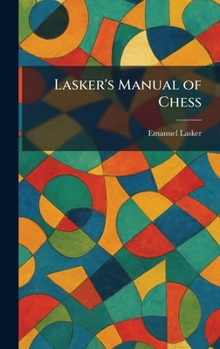
Lasker's Manual of Chess


Select Format
Select Condition 
Book Overview
"Lasker's Manual of Chess" is one of the most significant and enduring works in the history of chess literature. Written by Emanuel Lasker, who held the World Chess Championship for an unprecedented twenty-seven years, this comprehensive guide offers a profound exploration of the game's strategic and philosophical foundations. Rather than merely listing moves, Lasker delves into the underlying logic of chess, teaching readers how to think critically and adapt to the evolving demands of the board.
The manual is organized into systematic sections that cover the principles of opening play, the complexities of the middle game, and the technical precision required for the endgame. Lasker introduces his famous theory of "struggle," emphasizing that chess is not just a mathematical puzzle but a psychological contest between two minds. Through detailed analysis of classic games and positions, he illustrates the importance of position, development, and the economy of force.
Whether for a novice seeking to understand the basics or an advanced player looking to refine their tactical intuition, "Lasker's Manual of Chess" remains an essential resource. Its blend of practical instruction and intellectual depth ensures its status as a cornerstone of chess education, reflecting the genius of one of the game's greatest masters.
This work has been selected by scholars as being culturally important, and is part of the knowledge base of civilization as we know it. This work was reproduced from the original artifact, and remains as true to the original work as possible. Therefore, you may see the original copyright references, library stamps (as most of these works have been housed in our most important libraries around the world), and other notations in the work.
This work is in the public domain in the United States of America, and possibly other nations. Within the United States, you may freely copy and distribute this work, as no entity (individual or corporate) has a copyright on the body of the work.
As a reproduction of a historical artifact, this work may contain missing or blurred pages, poor pictures, errant marks, etc. Scholars believe, and we concur, that this work is important enough to be preserved, reproduced, and made generally available to the public. We appreciate your support of the preservation process, and thank you for being an important part of keeping this knowledge alive and relevant.
Customer Reviews
Introduces chess and goes well beyond
The Best Chess Book Ever?
Great For High School and Above Players
Can't argue with Lasker
Highly recommended.
ThriftBooks ® and the ThriftBooks ® logo are registered trademarks of Thrift Books Global, LLC
