


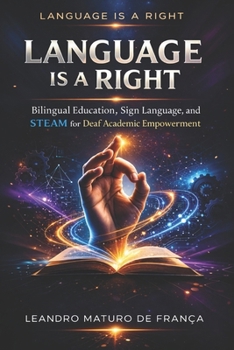
Language Is a Right: Bilingual Education, Sign Language, and STEAM for Deaf Academic Empowerment

A Global Framework for Bilingual Education and STEAM in Deaf Learning
A child can sit in a classroom for years...
and still never truly access education.
Around the world, deaf students are physically present in schools, yet linguistically excluded from full academic participation. Lessons are delivered. Content is explained. Standards are maintained.
But without language, knowledge does not arrive.
Language Is a Right confronts one of the most persistent structural failures in global education: the confusion between inclusion and access.
This book argues that the central issue in deaf education is not ability - it is linguistic coherence.
When Sign Language is recognized as a natural and structured first language (L1), and when the national written language is intentionally taught as a second language (L2), educational transformation becomes possible.
Grounded in classroom practice and aligned with international human rights principles, this work presents a globally applicable framework that integrates:
Bilingual education for deaf students
Visual modality as cognitive structure
STEAM methodology as pedagogical amplifier
Institutional responsibility and policy alignment
High academic expectations without simplification
By articulating language rights with Science, Technology, Engineering, Arts, and Mathematics, the book demonstrates how experimentation, project-based learning, and visual organization can dismantle linguistic barriers and foster true academic agency.
This is not a manual of accommodation.
It is a call for linguistic justice.
It is an invitation to move beyond symbolic inclusion toward structured, intentional, and globally coherent educational practice.
For educators, school leaders, researchers, and policymakers committed to equitable innovation, Language Is a Right offers both conceptual depth and practical direction.
The future of education cannot be technologically advanced and linguistically exclusionary at the same time.
Language is a right.
Education must reflect that truth.
Customer Reviews
ThriftBooks ® and the ThriftBooks ® logo are registered trademarks of Thrift Books Global, LLC
