


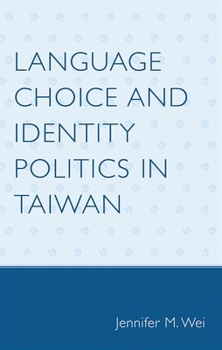
Language Choice and Identity Politics in Taiwan
No Customer Reviews

Select Format
Select Condition 
Book Overview
Jennifer M. Wei argues that construction and perceptions of language and identity parallel sociopolitical transformations, and language and identity crises arise during power transitions. Under these premises, language and identity are never well-defined or well-bounded. Instead, they are best viewed as political symbols subject to manipulation and exploitation during socio-historical upheavals. A choice of language--from phonological shibboleth, Mandarin, or Taiwanese, to choice of official language--cuts to the heart of contested cultural notions of self and other, with profound implications for nationalism, national unity and ethno-linguistic purism. Wei further argues that because of the Chinese Diaspora and Taiwan's connections to China and the United States, arguments and sentiments over language choice and identity have consequences for Taiwan's international and transnational status. They are symbolic acts of imagining Taiwan's past as she looks forward to the future.
Format:Paperback
Language:English
ISBN:073912353X
ISBN13:9780739123539
Release Date:August 2015
Publisher:Lexington Books
Length:152 Pages
Weight:0.55 lbs.
Dimensions:0.6" x 5.9" x 8.9"
Customer Reviews
0 rating
Copyright © 2026 Thriftbooks.com
Terms of Use | Privacy Policy | Do Not Sell/Share My Personal Information | Cookie Policy | Cookie Preferences | Accessibility Statement
ThriftBooks ® and the ThriftBooks ® logo are registered trademarks of Thrift Books Global, LLC
ThriftBooks ® and the ThriftBooks ® logo are registered trademarks of Thrift Books Global, LLC
