


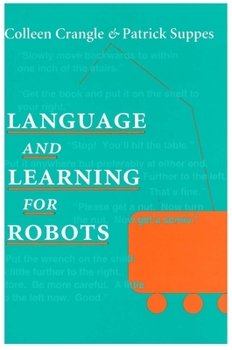
Language and Learning for Robots: Volume 41
No Customer Reviews

Select Format
Select Condition 
Book Overview
Robot technology will find wide-scale use only when a robotic device can be given commands and taught new tasks in a natural language. How could a robot understand instructions expressed in English? How could a robot learn from instructions? Crangle and Suppes begin to answer these questions through a theoretical approach to language and learning for robots and by experimental work with robots. The authors develop the notion of an instructable robot--one which derives its intelligence in part from interaction with humans. Since verbal interaction with a robot requires a natural language semantics, the authors propose a natural-model semantics which they then apply to the interpretation of robot commands. Two experimental projects are described which provide natural-language interfaces to robotic aids for the physically disabled. The authors discuss the specific challenges posed by the interpretation of "stop" commands and the interpretation of spatial prepositions. The authors also examine the use of explicit verbal instruction to teach a robot new procedures, propose ways a robot can learn from corrective commands containing qualitative spatial expressions, and discuss the machine-learning of a natural language use to instruct a robot in the performance of simple physical tasks. Two chapters focus on probabilistic techniques in learning.
Format:Paperback
Language:English
ISBN:1881526194
ISBN13:9781881526193
Release Date:November 1994
Publisher:Center for the Study of Language and Informat
Length:276 Pages
Weight:1.08 lbs.
Dimensions:0.8" x 6.1" x 9.0"
Customer Reviews
0 rating
Copyright © 2026 Thriftbooks.com
Terms of Use | Privacy Policy | Do Not Sell/Share My Personal Information | Cookie Policy | Cookie Preferences | Accessibility Statement
ThriftBooks ® and the ThriftBooks ® logo are registered trademarks of Thrift Books Global, LLC
ThriftBooks ® and the ThriftBooks ® logo are registered trademarks of Thrift Books Global, LLC
