


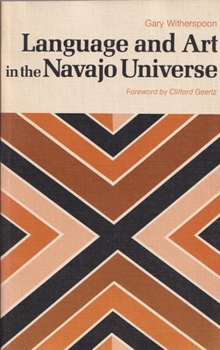
Language and Art in the Navajo Universe

This is a complex and theoretical study on the roles of language and art in Navajo culture, resulting from nearly a decade of research on the Navajo reservation. The structures of Navajo thought, language, speech, and knowledge are used to frame discussions on a number of topics. Primary among these from a cosmological perspective are the concepts of inner and outer forms in the duality on nature coupled with static and dynamic concepts of motion. Also explored is the importance of language in ritual control and perceptions of action, causality, and plurality. Two terms essential to the Navajo ethos are semantically explored as organizing principles. The first is the concept of k'T which finds its primary expression in the patterning of kin relationships and solidarity. The second is h=zh=, which is most easily glossed as representing Navajo ideals of harmony and order. Art examples, represented by music, sand painting, and weaving, are used to demonstrate how these complex semantic and cosmological considerations find their way into Navajo daily ritual life. Information is also included on color classification, numerology, mythology, ethnophysocology, and taxonomies. The conclusions expand the data into summary statements of Navajo ethos.
Format:Paperback
Language:English
ISBN:0472089668
ISBN13:9780472089666
Release Date:September 1977
Publisher:University of Michigan Press
Length:244 Pages
Weight:0.94 lbs.
Dimensions:0.7" x 6.0" x 9.2"
Customer Reviews
1 rating
a phenomenal book
Published by Thriftbooks.com User , 16 years ago
Witherspoon, a professor at the Univ. of Michigan, uses language as an entry way into a world-view and a way of Being that is totally alien to many if not most, Anglos. The Navajo universe was created and organized through language as the thought, conceived by Holy Beings, was projected onto the primordial unordered substance through the compulsive power of speech and song. Language then, is an energetic medium that affects the very entrails of reality. Thought then, for a Navajo, is a creative tool for ordering reality. That's why the ability to speak eloquently, and think beautiful & creative thoughts, is highly praised. A child acquires human status only after it has started to speak. In this book i've found excellent descriptions of the Blessingway ceremony and various other curing rites (designed to recreate the world through myth, song, prayer and language). This includes the best (by far) explanation of the famous Navajo phrase "sa'ah naaghaii bik'eh hozho" that Navajos use to refer to a "beautiful, pleasant and healthy environment". The phrase which represent a maelstrom of meanings is firmly rooted into Navajo mythology and thus often considered untranslatable. Moreover, Clyde Kluckhohn (the 'grandfather of Navajo anthropology) often says that English lacks terms that have simultaneously moral and aesthetic meanings and hence cannot be used to comprehend Navajos. Witherspoon tells us that the principal verb in the Navajo language is not "to be" like in many other languages (including ours); "to be" is of minor importance in Navajo. Instead, the Navajo language contains some 356,200 distinct conjugations of the verb "to go", reflecting emphasis on movement and change. Movement, song, speech and life are, for a Navajo, inseparably linked. What does such ordering of the world - in terms of change and movement, instead of the emphasis on the "self" - mean for the Navajo sense of being in the world? W. explains it all in this fascinating, hard-to-put-down book. The book includes much analysis of genealogical terms and their relationships based on sex, generation, relative age and relative distance. Being born into a clan fixes the social context of the person clearly, precisely and unalterably while the language terms used to negotiate the social and spiritual interactions change depending on the context (the brilliant discussion of k'e terms in Chapter 3). In other words, the Navajo language is analyzed and investigated by W. as an organic aspect of a culture, its evolution and its mythos. This is cultural anthropology & linguistics at its best. A few quotes to get the sense of the book (P.151): "For the Navajo, beauty is not so much in the eye of the beholder as it is in the mind of its creator and in creator's relationship to the created. The Navajo does not look for beauty; he generates it within himself and projects it onto the universe. Beauty is a creation of thought....[...]..the Navajo experience beauty primarily through
Copyright © 2026 Thriftbooks.com Terms of Use
| Privacy Policy | Do Not
Sell/Share My Personal Information | Cookie Policy | Cookie Preferences | Accessibility Statement
ThriftBooks® and the ThriftBooks® logo are registered trademarks of Thrift Books Global, LLC
ThriftBooks® and the ThriftBooks® logo are registered trademarks of Thrift Books Global, LLC
