


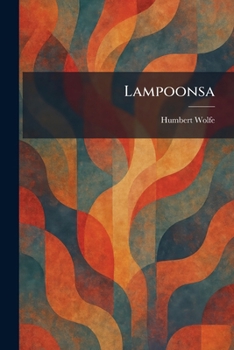
Lampoonsa

"Lampoonsa" is a sharp and witty collection of satirical verse by the renowned English poet Humbert Wolfe. Published during the height of his literary career in the mid-1920s, this work showcases Wolfe's mastery of the epigrammatic form and his keen eye for the social and literary foibles of his era. The poems serve as brief, biting caricatures of contemporary figures and types, blending humor with a sophisticated literary sensibility.
As a significant contribution to the tradition of British satire, "Lampoonsa" demonstrates the author's ability to condense complex character traits and public reputations into a few pithy lines. Wolfe's verse is characterized by its technical precision and rhythmic grace, making the sting of his satire all the more effective. This collection offers readers a fascinating glimpse into the intellectual and cultural landscape of the early 20th century, capturing the spirit of an age through the lens of one of its most celebrated lyrical poets.
Whether skewering politicians, fellow writers, or social figures, Wolfe maintains a balance of playful irreverence and intellectual depth. "Lampoonsa" remains a compelling volume for those interested in the history of English verse and the enduring power of literary caricature.
This work has been selected by scholars as being culturally important, and is part of the knowledge base of civilization as we know it. This work was reproduced from the original artifact, and remains as true to the original work as possible. Therefore, you may see the original copyright references, library stamps (as most of these works have been housed in our most important libraries around the world), and other notations in the work.
This work is in the public domain in the United States of America, and possibly other nations. Within the United States, you may freely copy and distribute this work, as no entity (individual or corporate) has a copyright on the body of the work.
As a reproduction of a historical artifact, this work may contain missing or blurred pages, poor pictures, errant marks, etc. Scholars believe, and we concur, that this work is important enough to be preserved, reproduced, and made generally available to the public. We appreciate your support of the preservation process, and thank you for being an important part of keeping this knowledge alive and relevant.
Customer Reviews
ThriftBooks ® and the ThriftBooks ® logo are registered trademarks of Thrift Books Global, LLC
