


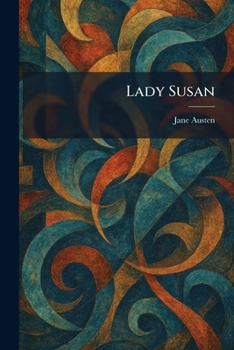
Lady Susan


Select Format
Select Condition 
Book Overview
"Lady Susan" is a short epistolary novel by Jane Austen, showcasing the author's sharp wit and keen observation of social manners. Unlike the more traditional heroines found in her later works, the titular Lady Susan Vernon is a beautiful, charming, and thoroughly manipulative widow. Determined to find a suitable husband for her daughter while securing a beneficial match for herself, she navigates the complexities of high society with calculated schemes and flirtatious deception.
Written through a series of letters, the narrative provides an intimate look into the motivations and personalities of its characters. Austen explores themes of power, social standing, and the constraints placed upon women during the Regency era. The work stands out for its portrayal of a protagonist who defies the moral expectations of her time, making it a compelling study of character and social artifice. This classic work offers readers a unique glimpse into Austen's early literary development and her enduring talent for satire and psychological depth.
This work has been selected by scholars as being culturally important, and is part of the knowledge base of civilization as we know it. This work was reproduced from the original artifact, and remains as true to the original work as possible. Therefore, you may see the original copyright references, library stamps (as most of these works have been housed in our most important libraries around the world), and other notations in the work.
This work is in the public domain in the United States of America, and possibly other nations. Within the United States, you may freely copy and distribute this work, as no entity (individual or corporate) has a copyright on the body of the work.
As a reproduction of a historical artifact, this work may contain missing or blurred pages, poor pictures, errant marks, etc. Scholars believe, and we concur, that this work is important enough to be preserved, reproduced, and made generally available to the public. We appreciate your support of the preservation process, and thank you for being an important part of keeping this knowledge alive and relevant.
Customer Reviews
Some Lady!
An early work that is outrageously fun and artfully melodramatic
Jane Austen's least known novel is one of her wittiest and most charming.
It's Austen. What's not to like?
Jane Austen's least known novel is one of her wittiest and most charming.
ThriftBooks ® and the ThriftBooks ® logo are registered trademarks of Thrift Books Global, LLC
