


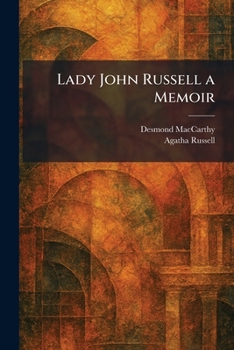
Lady John Russell a Memoir

"Lady John Russell a Memoir" offers an intimate and comprehensive look into the life of Frances Anna Maria Elliott, the second wife of the prominent British statesman and Prime Minister Lord John Russell. Compiled and edited by Desmond MacCarthy and Agatha Russell, this work serves as both a personal biography and a significant historical record of the Victorian era's political and social spheres.
The memoir traces Lady Russell's journey from her upbringing in a noble Scottish family to her influential position at the heart of the British Empire. Through personal letters, diaries, and recollections, the text reveals her sharp intellect, deep moral convictions, and unwavering support for her husband during his turbulent political career. It provides a rare perspective on the inner workings of the Whig party and the challenges of leadership during a time of immense social reform and international change.
Beyond its political insights, "Lady John Russell a Memoir" illuminates the private life of a remarkable woman who navigated the complexities of high society with grace and integrity. This volume is an essential resource for those interested in Victorian history, British politics, and the vital roles women played behind the scenes of 19th-century government.
This work has been selected by scholars as being culturally important, and is part of the knowledge base of civilization as we know it. This work was reproduced from the original artifact, and remains as true to the original work as possible. Therefore, you may see the original copyright references, library stamps (as most of these works have been housed in our most important libraries around the world), and other notations in the work.
This work is in the public domain in the United States of America, and possibly other nations. Within the United States, you may freely copy and distribute this work, as no entity (individual or corporate) has a copyright on the body of the work.
As a reproduction of a historical artifact, this work may contain missing or blurred pages, poor pictures, errant marks, etc. Scholars believe, and we concur, that this work is important enough to be preserved, reproduced, and made generally available to the public. We appreciate your support of the preservation process, and thank you for being an important part of keeping this knowledge alive and relevant.
Customer Reviews
ThriftBooks ® and the ThriftBooks ® logo are registered trademarks of Thrift Books Global, LLC
