


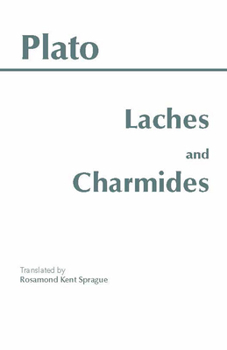
Laches and Charmides (Hackett Classics)


Select Format
Select Condition 
Book Overview
Laches and Charmides, written by legendary author Plato is widely considered to be one of the greatest books of all time. This great classic will surely attract a whole new generation of readers. For... This description may be from another edition of this product.
Format:Paperback
Language:English
ISBN:0872201341
ISBN13:9780872201347
Release Date:October 1992
Publisher:Hackett Publishing Company, Inc.
Length:112 Pages
Weight:0.34 lbs.
Dimensions:8.8" x 0.3" x 5.5"
Customer Reviews
2 ratings
The classical Greek search for the virtue of courage
Published by Thriftbooks.com User , 16 years ago
I read this book for a graduate philosophy class. The classical Greek philosophers Socrates, Plato, and Aristotle were the midwives of Western civilization's "birth" of philosophy. Prior to the fifth century BCE classical Greek period, Greek citizens learned about virtuous actions including courage through their mythical religious beliefs, and epic poetry; such as, Homer's Iliad and The Odyssey. Thus, not until Socrates asks the question of what does the "good life" consists of do people ponder with reason and logic as their guide what constitutes virtues and how to practice them. Plato, like Socrates before him and Aristotle after him, believes in a virtue-based code of ethics where the end goal is to attain "happiness" which is understood by the classical Greeks as a flourishing" and is obtained only by performing virtuous acts. Plato's short dialogue Laches is his literary vehicle to show Socrates exploring the virtue of courage. Socrates questions two famous Greek generals, Nicias and Laches, who participated in the Peloponnesian War, as did Socrates, in order to get at a definition of courage. The virtue of courage figures prominently in the second half of Plato's dialogue when Socrates asks both generals to define courage. It is important to note that though Socrates is the first philosopher to embark upon a search for a definition of virtue, he did not write his philosophy down. All of what we know of Socrates' teachings comes from the pen of Plato, one of his most devoted students. Laches first defines courage for Socrates by providing him three components of courage. A courageous person is "willing," "stands their ground in the face of the enemy," and "does not run." Laches' three components of courage are really just examples of the time-honored duty of Greek patriotism, which is derived out of a feeling or emotional attachment to one's country. In essence, the Greek citizen is "willing" to act out of a sense of duty to their city; "standing their ground" to protect their city from enemy attack. The citizen "does not run" in fear for their lives risking the safety of their city. Essentially, Plato's summation of these three components as spoken by Laches, is that courage comes from an "endurance of the soul." (p 34, (192c). Up to this point in the dialogue, Plato's definition of courage does not differ from the standard Homeric definition. However, when Socrates continues his questioning of Laches, he expands the scope of courageous actions to encompass perils of illness, sea travel and even into the political realm in hopes of better defining courage. Thus, Plato recognizes that there is a host of situations that requires a person to use courage to surmount whatever dangerous predicament they face. By posing the question this way, Plato through Socrates assumes that there is something else that people rely on to make them courageous. This is the real crux of the dialogue; to find out what else there is in the hum
In search of courage and temperance
Published by Thriftbooks.com User , 23 years ago
In these two dialogues, Socrates seeks to discover the true nature of virtue by trying to define a single virtue, namely courage in the Laches and temperance in the Charmides. In the first text, two men have sought the counsel of two generals, Nicias and Laches, for advice in how to educate their sons to be good and virtuous men. Socrates is soon brought into the conversation, and he predictably shifts the discussion from one of means to one of ends. Socrates says that the best education is one for the benefit of the boys' souls, namely virtue. Before one can find a teacher of virtue, one must understand what virtue is. He proposes to simplify matters by seeking to define one aspect of virtue, namely courage. Nicias and Laches offer such definitions as a sort of endurance of the soul and a knowledge of the fearful and the hopeful in war, but Socrates identifies problems with each proffered definition. The dialogue ends with each man admitting failure. In the Charmides, a similar debate takes place, only this time it is a different aspect of virtue, namely temperance, which the men attempt to define. The young philosopher Charmides, whose beauty initially overwhelms Socrates, first says that temperance consists of doing things in an orderly and quiet way; when Socrates points out the inadequacy of such a definition, Charmides says that temperance is a form of modesty. When Socrates proves to him that modesty can be both good and bad, he retreats and refers to someone else's notion that temperance consists of minding one's own business. Critias then jumps into the fray to defend this third position; once he is put on the defensive, he falls back on two alternate definitions--first, that temperance consists of doing good things, and then that temperance is equivalent to knowing oneself. In the end, no satisfactory definition of temperance is arrived at, although one is left with the impression that temperance has much to do with the knowledge of good and evil.These two dialogues are rather short, and they do succeed in demonstrating the effective yet annoying method of Socrates' philosophic inquiries. I found Charmides to be a somewhat harder text to follow because it sometimes broke down into wild abstractions, but both texts are quite readable in terms of the narrative style of the writing. Rosamond Kent Sprague, the translator, provides many useful footnotes throughout the book, and, more importantly, offers a very helpful introduction to each dialogue. Each introduction sets the context and timeframe for the particular dialogue, offers a basic rundown of its main ideas and arguments, and basically makes each text much more accessible and readable for this reader.
Copyright © 2026 Thriftbooks.com Terms of Use
| Privacy Policy | Do Not
Sell/Share My Personal Information | Cookie Policy | Cookie Preferences | Accessibility Statement
ThriftBooks® and the ThriftBooks® logo are registered trademarks of Thrift Books Global, LLC
ThriftBooks® and the ThriftBooks® logo are registered trademarks of Thrift Books Global, LLC
