


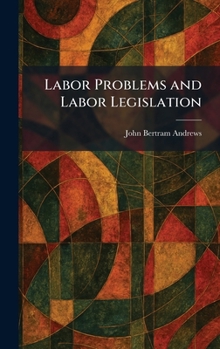
Labor Problems and Labor Legislation

Select Format
Select Condition 
Book Overview
"Labor Problems and Labor Legislation" provides a comprehensive overview of the socio-economic challenges facing workers in the early twentieth century and the legislative solutions designed to address them. Written by John B. Andrews, a prominent advocate for worker protections, this work serves as an essential guide to the history and development of workplace regulations.
The book delves into critical issues such as employment insecurity, the struggle for a living wage, and the necessity of limiting working hours. It also explores the vital importance of safety and health standards in industrial environments, the abolition of child labor, and the foundations of social insurance programs. Through clear analysis and a focus on social justice, Andrews illustrates how labor legislation evolved to prevent exploitation and promote the general welfare of the public.
This text is a significant historical document for readers interested in the roots of modern employment law, industrial relations, and the labor movement. By examining the interplay between economic theory and public policy, "Labor Problems and Labor Legislation" remains a foundational resource for understanding the legislative efforts that shaped the modern workplace and protected the rights of the worker.
This work has been selected by scholars as being culturally important, and is part of the knowledge base of civilization as we know it. This work was reproduced from the original artifact, and remains as true to the original work as possible. Therefore, you may see the original copyright references, library stamps (as most of these works have been housed in our most important libraries around the world), and other notations in the work.
This work is in the public domain in the United States of America, and possibly other nations. Within the United States, you may freely copy and distribute this work, as no entity (individual or corporate) has a copyright on the body of the work.
As a reproduction of a historical artifact, this work may contain missing or blurred pages, poor pictures, errant marks, etc. Scholars believe, and we concur, that this work is important enough to be preserved, reproduced, and made generally available to the public. We appreciate your support of the preservation process, and thank you for being an important part of keeping this knowledge alive and relevant.
Customer Reviews
ThriftBooks ® and the ThriftBooks ® logo are registered trademarks of Thrift Books Global, LLC
