


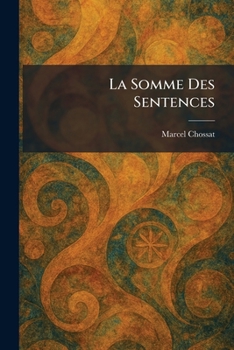
La Somme Des Sentences

Select Format
Select Condition 
Book Overview
"La Somme Des Sentences" is a profound scholarly exploration of medieval scholastic theology, focusing on the "Summa Sententiarum", a pivotal text from the 12th century. Written by the Jesuit theologian Marcel Chossat, this work meticulously analyzes the origins, authorship, and doctrinal significance of this influential treatise, which played a crucial role in the development of systematic theology. Chossat investigates the complex historical context of the work, often linked to the School of Saint Victor, and its impact on later thinkers like Peter Lombard.
The volume offers an in-depth examination of central Christian dogmas, including the sacraments and the Trinity, illustrating how medieval scholars synthesized earlier traditions into a coherent theological framework. By providing a detailed study of the "Summa's" structure and content, the author sheds light on the transition toward the high scholasticism of the 13th century. This work remains an essential resource for those interested in the history of the Church, medieval philosophy, and the evolution of religious thought. Chossat's rigorous academic approach provides a clear window into the intellectual rigor and spiritual concerns of the medieval mind.
This work has been selected by scholars as being culturally important, and is part of the knowledge base of civilization as we know it. This work was reproduced from the original artifact, and remains as true to the original work as possible. Therefore, you may see the original copyright references, library stamps (as most of these works have been housed in our most important libraries around the world), and other notations in the work.
This work is in the public domain in the United States of America, and possibly other nations. Within the United States, you may freely copy and distribute this work, as no entity (individual or corporate) has a copyright on the body of the work.
As a reproduction of a historical artifact, this work may contain missing or blurred pages, poor pictures, errant marks, etc. Scholars believe, and we concur, that this work is important enough to be preserved, reproduced, and made generally available to the public. We appreciate your support of the preservation process, and thank you for being an important part of keeping this knowledge alive and relevant.
Customer Reviews
ThriftBooks ® and the ThriftBooks ® logo are registered trademarks of Thrift Books Global, LLC
