


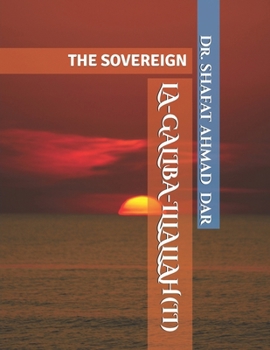
La-Galiba-Illallah: The Sovereign
No Customer Reviews

To embark upon a journey toward the Divine is to first acknowledge the inherent limitations of the vessel in which we travel. We are bound by a nervous system, a complex network of neurons, and an intricate endocrine system that, while miraculous, acts as a biological veil between our consciousness and the Absolute. To attempt to define God through the narrow lens of human logic, memory, or dimension is a paradox; the moment we wrap words around the Infinite, we begin to distance ourselves from its actual reality. This book is not an attempt to capture the sun in a jar, but rather an exploration of the light that filters through our finite windows.
We must humbly accept that our senses are feeble instruments, granted by the very Force they seek to measure. If the Absolute is truly absolute, it exists far beyond the reach of human comprehension, occupying realms that do not resemble any known natural thinking or cognitive structure. Our intelligence is merely a subset of a much larger reality, a minuscule domain within a vast, extra-celestial existence. Thus, this work does not claim to know the "nature" of God, for that nature is fundamentally unknowable; instead, it seeks to observe the "qualities" of that presence as they reflect upon our existence.
One of the most significant barriers to understanding the Absolute is our tendency to project human biological needs onto the Divine. God does not need to have sex, nor does the Absolute have a son, daughter, or wife in any physical form. These are human constructs born of our own reproductive requirements and social structures. God exists independently of these biological imperatives, standing as a creative force that does not require a partner or a lineage to validate its existence or its power.
God occupies a dual position in the universe as both an independent and a dependent quantity, yet even this description falls short. There are certain domains of the Divine that are neither static nor variable, neither dependent nor independent. These aspects are entirely out of our domain of intelligence. They do not resemble any known pattern of human thought, and because they lack a reference point in our physical experience, they will remain forever hidden from our comprehension.
There is an ancient question regarding whether we are part of God or separate creations kept outside of His existence. The perspective explored here suggests that we reside within a small portion of the basic existence of God. While the Absolute, in His higher realms, is infinitely larger than the known universe, a miniscule portion of that existence forms the fabric of our reality. In this sense, God is present everywhere: in the laptop, the book, the pillow, and even within the very cells of our bodies.
The governance of the universe is maintained through a series of laws and principles established by the Absolute. While God is sovereign and possesses the will to change these laws at any moment, He does not do so. This consistency is not a limitation of power, but an expression of it. By adhering to the laws of physics and gravity, the Divine provides a stable stage upon which the drama of existence can unfold, ensuring that the universe remains a place of order rather than chaotic whim.
God is, by definition, eternal and absolute. In those major portions of His existence that lie beyond our universe, He is spaceless and timeless. He exists in a state where "before" and "after" have no meaning, and where "here" and "there" collapse into a singular reality. This timelessness is the backdrop against which our fleeting lives are set, a reminder that our perception of time is merely a local phenomenon relevant only to our physical forms.
We must humbly accept that our senses are feeble instruments, granted by the very Force they seek to measure. If the Absolute is truly absolute, it exists far beyond the reach of human comprehension, occupying realms that do not resemble any known natural thinking or cognitive structure. Our intelligence is merely a subset of a much larger reality, a minuscule domain within a vast, extra-celestial existence. Thus, this work does not claim to know the "nature" of God, for that nature is fundamentally unknowable; instead, it seeks to observe the "qualities" of that presence as they reflect upon our existence.
One of the most significant barriers to understanding the Absolute is our tendency to project human biological needs onto the Divine. God does not need to have sex, nor does the Absolute have a son, daughter, or wife in any physical form. These are human constructs born of our own reproductive requirements and social structures. God exists independently of these biological imperatives, standing as a creative force that does not require a partner or a lineage to validate its existence or its power.
God occupies a dual position in the universe as both an independent and a dependent quantity, yet even this description falls short. There are certain domains of the Divine that are neither static nor variable, neither dependent nor independent. These aspects are entirely out of our domain of intelligence. They do not resemble any known pattern of human thought, and because they lack a reference point in our physical experience, they will remain forever hidden from our comprehension.
There is an ancient question regarding whether we are part of God or separate creations kept outside of His existence. The perspective explored here suggests that we reside within a small portion of the basic existence of God. While the Absolute, in His higher realms, is infinitely larger than the known universe, a miniscule portion of that existence forms the fabric of our reality. In this sense, God is present everywhere: in the laptop, the book, the pillow, and even within the very cells of our bodies.
The governance of the universe is maintained through a series of laws and principles established by the Absolute. While God is sovereign and possesses the will to change these laws at any moment, He does not do so. This consistency is not a limitation of power, but an expression of it. By adhering to the laws of physics and gravity, the Divine provides a stable stage upon which the drama of existence can unfold, ensuring that the universe remains a place of order rather than chaotic whim.
God is, by definition, eternal and absolute. In those major portions of His existence that lie beyond our universe, He is spaceless and timeless. He exists in a state where "before" and "after" have no meaning, and where "here" and "there" collapse into a singular reality. This timelessness is the backdrop against which our fleeting lives are set, a reminder that our perception of time is merely a local phenomenon relevant only to our physical forms.
Format:Paperback
Language:English
ISBN:B0GHS23CQ4
ISBN13:9798244722765
Release Date:January 2026
Publisher:Independently Published
Length:148 Pages
Weight:0.79 lbs.
Dimensions:0.3" x 8.5" x 11.0"
Related Subjects
PhilosophyCustomer Reviews
0 rating
Copyright © 2026 Thriftbooks.com Terms of Use
| Privacy Policy | Do Not
Sell/Share My Personal Information | Cookie Policy | Cookie Preferences | Accessibility Statement
ThriftBooks® and the ThriftBooks® logo are registered trademarks of Thrift Books Global, LLC
ThriftBooks® and the ThriftBooks® logo are registered trademarks of Thrift Books Global, LLC
