


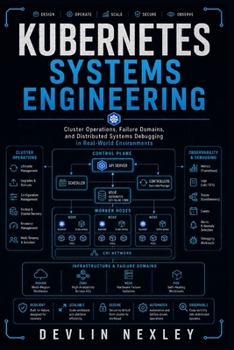
Kubernetes Systems Engineering

Kubernetes is often described as a container orchestration platform. In production environments, it is something far more significant: a distributed control system responsible for continuously reconciling infrastructure state across thousands of interconnected components.
Beneath every deployed workload lies a complex architecture of control loops, consensus-driven state management, scheduling algorithms, networking abstractions, storage orchestration layers, security enforcement mechanisms, and observability pipelines. Understanding how these subsystems interact is the difference between simply operating Kubernetes and engineering reliable cloud-native platforms at scale.
Kubernetes Control Systems Engineering approaches Kubernetes from the perspective of distributed systems architecture and production operations. Rather than focusing on deployment tutorials or certification objectives, this book explores the internal mechanisms that drive cluster behavior, the control paths that govern state convergence, and the operational realities encountered when large-scale Kubernetes environments experience failure, instability, or growth.
Written for experienced engineers, platform teams, SREs, DevOps practitioners, and infrastructure architects, this book examines Kubernetes as a living control plane whose behavior emerges from the interaction of independent controllers, asynchronous reconciliation loops, distributed state stores, and dynamic workload execution systems.
Inside, you will explore:
Control plane architecture and component interactions
API server internals, watch mechanisms, and state propagation
etcd and distributed state management fundamentals
Controller design and reconciliation loop behavior
Scheduler architecture, placement decisions, and workload arbitration
Pod lifecycle execution from scheduling through runtime enforcement
CNI networking architecture and packet flow across cluster boundaries
Service discovery, DNS resolution, ingress, and traffic routing systems
Persistent storage orchestration through CSI and stateful workload patterns
RBAC authorization models, admission control pipelines, and policy enforcement
Observability architectures for metrics, logging, events, and tracing
Infrastructure debugging methodologies for complex production incidents
Failure domains, cascading outages, and recovery strategies
High-availability control plane design and disaster recovery engineering
Cluster upgrades, lifecycle management, and operational resilience
Practical approaches to diagnosing and restoring state convergence under pressure
Throughout the book, theoretical concepts are connected directly to operational realities. You will learn how Kubernetes components communicate, how failures propagate through subsystem boundaries, how controllers recover from inconsistent state, and how experienced operators reason about infrastructure during active incidents.
Instead of treating Kubernetes resources as isolated objects, you will learn to view clusters as interconnected distributed systems whose behavior is driven by reconciliation, scheduling, networking, storage, and policy enforcement engines working in parallel.
Customer Reviews
ThriftBooks ® and the ThriftBooks ® logo are registered trademarks of Thrift Books Global, LLC
