


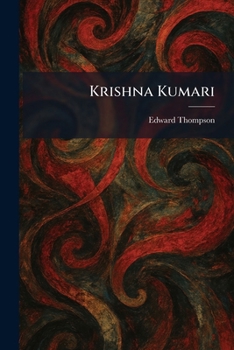
Krishna Kumari

"Krishna Kumari" is a compelling verse drama by Edward Thompson that breathes life into one of the most poignant episodes of Rajput history. Set against the backdrop of early nineteenth-century India, the play dramatizes the tragic fate of the young Princess of Mewar, whose beauty and royal lineage become the catalyst for a devastating conflict between the rival states of Jaipur and Jodhpur. As the princely states teeter on the brink of war over her hand in marriage, Krishna Kumari faces an impossible choice to ensure the survival of her kingdom.
Thompson's work masterfully explores themes of honor, duty, and sacrifice, capturing the intricate political landscape of Rajasthan during a period of intense upheaval. Through vivid dialogue and dramatic tension, the play portrays the internal struggles of the Mewar court and the stoic resolution of a princess caught in the gears of power politics. This tragedy serves as both a literary exploration of Indian folklore and a profound study of the human cost of dynastic pride. "Krishna Kumari" remains a significant contribution to the body of Anglo-Indian literature, offering readers a window into the romanticized yet brutal realities of the princely states of India.
This work has been selected by scholars as being culturally important, and is part of the knowledge base of civilization as we know it. This work was reproduced from the original artifact, and remains as true to the original work as possible. Therefore, you may see the original copyright references, library stamps (as most of these works have been housed in our most important libraries around the world), and other notations in the work.
This work is in the public domain in the United States of America, and possibly other nations. Within the United States, you may freely copy and distribute this work, as no entity (individual or corporate) has a copyright on the body of the work.
As a reproduction of a historical artifact, this work may contain missing or blurred pages, poor pictures, errant marks, etc. Scholars believe, and we concur, that this work is important enough to be preserved, reproduced, and made generally available to the public. We appreciate your support of the preservation process, and thank you for being an important part of keeping this knowledge alive and relevant.
Customer Reviews
ThriftBooks ® and the ThriftBooks ® logo are registered trademarks of Thrift Books Global, LLC
