


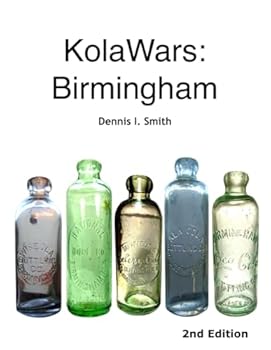
KolaWars Birmingham
No Customer Reviews

In 1913, the residents of Birmingham drank more Coca-Cola than those in any city in the world. Crawford Johnson's Birmingham Coca-Cola Bottling Company had a capacity of 40,000 bottles a day and surpassed even Atlanta in the number of bottles sold. But the citizens of Birmingham and Jefferson County were drinking more than Coca-Cola, they were also drinking Ala-Cola and Alpha, Cafa-Cola and Cola-Nip, Fan-Taz and Glee-Cola, My-Coca and Nifty-Cola, Pep-To-Lac and Pepsi-Cola, Rye-Ola and Wiseola. No city in the country could compare with the number of brand name and proprietary soft drinks that were produced in the city of Birmingham prior to 1920. Many of these beverages were homegrown: developed locally by Alabama men and women and sold across the United States. Rye-Ola was bottled as far as Oregon, My-Coca from Pennsylvania to California. Others found markets regionally in Georgia, Tennessee, Florida, Mississippi, and other nearby states. Ala-Cola was bottled in Europe and Celery-Cola was sold in Canada, Mexico, Panama, Cuba, and as far as Australia.Birmingham is also unique in the number of brand name beverages bottled in embossed Hutchinson bottles: Ala-Cola, Celery Cola, Coca-Cola, Dope, and Wiseola. Some of these beverages were intended to ride on the successful coattails of Coca-Cola and found themselves in court as a result. Whether selecting a similar name such as Cola-Co or Fletchers Coca-Cola or using stolen bottles with the Coca-Cola trademark, these imitators found the Coca-Cola Company ready to protect its trademark and business in court.Several local soft drinks were caught up in a sting operation run by the United States Department of Agriculture out of New Orleans. They were brought into Federal Court on violations of the Pure Food Act of 1906 and their reputations tarnished but brands survived.Many of these drinks were sold in bottles with the trade names embossed or applied. Examples of bottles with trade names embossed are pictured herein. Others were in bottles with simply a company name and flavors were identified by paper labels and caps. Bottles, labels, and advertising are pictured here along with photos of many of the plants where these drinks were bottled.The first section alphabetically the brand name soft drinks and their history from the 1890s to 1930, the era of embossed bottles. Following is a list of the brand name soft drinks from 1930 to the 1960s.
Format:Paperback
Language:English
ISBN:B0DC5QQC25
ISBN13:9798334845947
Release Date:August 2024
Publisher:Independently published
Length:130 Pages
Weight:0.88 lbs.
Dimensions:11.0" x 0.3" x 8.5"
Customer Reviews
0 rating
Copyright © 2026 Thriftbooks.com Terms of Use
| Privacy Policy | Do Not
Sell/Share My Personal Information | Cookie Policy | Cookie Preferences | Accessibility Statement
ThriftBooks® and the ThriftBooks® logo are registered trademarks of Thrift Books Global, LLC
ThriftBooks® and the ThriftBooks® logo are registered trademarks of Thrift Books Global, LLC
