


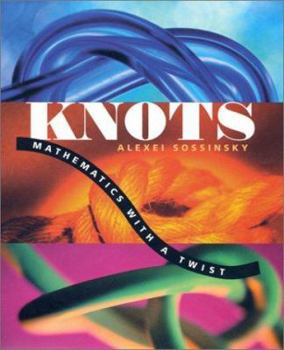
Knots: Mathematics with a Twist

Select Format
Select Condition 
Book Overview
Ornaments and icons, symbols of complexity or evil, aesthetically appealing and endlessly useful in everyday ways, knots are also the object of mathematical theory, used to unravel ideas about the topological nature of space. In recent years knot theory has been brought to bear on the study of equations describing weather systems, mathematical models used in physics, and even, with the realization that DNA sometimes is knotted, molecular biology. This book, written by a mathematician known for his own work on knot theory, is a clear, concise, and engaging introduction to this complicated subject. A guide to the basic ideas and applications of knot theory, Knots takes us from Lord Kelvin's early--and mistaken--idea of using the knot to model the atom, almost a century and a half ago, to the central problem confronting knot theorists today: distinguishing among various knots, classifying them, and finding a straightforward and general way of determining whether two knots--treated as mathematical objects--are equal. Communicating the excitement of recent ferment in the field, as well as the joys and frustrations of his own work, Alexei Sossinsky reveals how analogy, speculation, coincidence, mistakes, hard work, aesthetics, and intuition figure far more than plain logic or magical inspiration in the process of discovery. His spirited, timely, and lavishly illustrated work shows us the pleasure of mathematics for its own sake as well as the surprising usefulness of its connections to real-world problems in the sciences. It will instruct and delight the expert, the amateur, and the curious alike.
Format:Hardcover
Language:English
ISBN:0674009444
ISBN13:9780674009448
Release Date:December 2002
Publisher:Harvard University Press
Length:160 Pages
Weight:0.62 lbs.
Dimensions:7.8" x 1.3" x 6.5"
Customer Reviews
2 ratings
A Fun Book
Published by Thriftbooks.com User , 21 years ago
If you like mathematics, even if you did not major in math, read this book. It is written for both the non-mathematician and the Ph.D. mathematician. For a more rigorous introduction, see Prasolov and Sossinsky, Knots, Links, Braids and 3-Manifolds.
Untangling Mathematically
Published by Thriftbooks.com User , 23 years ago
It is always surprising and pleasing to find that mathematicians are busy in their ivory towers looking at non-numerical concepts and even using small subjects to turn out tomes that are impenetrable to us non-mathematicians. If you want to spend a little time learning how mathematicians think about the lowly subject of knots, there is now a little book with good illustrations and explanations that may go over the heads of most people, but nonetheless demonstrates the high degree of effort in this mathematical field. _Knots: Mathematics with a Twist_ (Harvard) by Alexei Sossinsky (who is a professor of mathematics at the University of Moscow; this work is translated by Giselle Weiss) demonstrates well the complexity of a field that might at first seem unpromising but actually has important relevance to the real world.The diagrams here, and there are many of them, are a great help. You could make your knot cross over and under an infinite number of different ways. But how different, and how can you tell the difference between one knot and another? There is, according to Sossinsky, no algorithm that works in every case of classification, not even an algorithm that can be taught to a computer. This is true even though the attempts at classification, with graphic or symbolic notation which cannot be reproduced here, are quite complicated. So, being able to tell one knot from another is the as yet unattained Holy Grail of knot theory. Interestingly, if you tie a knot, however simple, into a string, you cannot tie another knot, however complicated, into the string so that one knot will, when it meets the other, untie the string. The proof of the impossibility of one knot canceling out another is nicely sketched here. The chapters here are written more-or-less independently of one another, so that if one stumps you, you can try the next with a clean slate. For needed relief, Sossinsky has put in digressions (and labeled some of them as such) which any reader ought to be able to enjoy, like the one about the slime eel that knots itself for defenses (left trefoil knot). Some of the coincidences between knots, algebra, quantum theory, and other disparate lines of thought are really quite lovely, and indicate once again that no one knows where research in pure mathematics may lead or how practical it may turn out to be.Sossinsky has a witty style, and acknowledges how strange this mathematical world must be for visitors. At one point in demonstrating the procedure for composing a knot from primes, he parenthetically says of the task of making a rigorous definition of what he has described intuitively, "I will leave to the reader already corrupted by the study of mathematics the task." He is a genial guide to a strange land.
Copyright © 2026 Thriftbooks.com
Terms of Use | Privacy Policy | Do Not Sell/Share My Personal Information | Cookie Policy | Cookie Preferences | Accessibility Statement
ThriftBooks ® and the ThriftBooks ® logo are registered trademarks of Thrift Books Global, LLC
ThriftBooks ® and the ThriftBooks ® logo are registered trademarks of Thrift Books Global, LLC
