


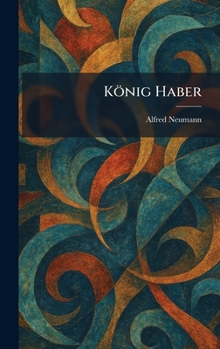
König Haber

"Konig Haber" is a compelling historical novella by the acclaimed author Alfred Neumann, set within the claustrophobic and treacherous atmosphere of a 19th-century German court. The narrative follows the life of Haber, a brilliant financier and "Court Jew" who rises to a position of significant influence as the trusted advisor to a Grand Duke. As Haber maneuvers through the complex social hierarchies and political machinations of the aristocracy, he finds himself caught in a delicate balance between his professional power and the precarious nature of his social standing.
Neumann masterfully crafts a psychological portrait of a man defined by his intellect and ambition, yet haunted by the inevitable prejudices of his environment. The work explores profound themes of identity, the burdens of leadership, and the tragic consequences of political hubris. Through Haber's interactions with the court and his ultimate fall from grace, the story examines the fragile intersection of personal loyalty and state interest.
Written with dramatic intensity and literary elegance, "Konig Haber" is a significant example of early 20th-century historical fiction. It offers a nuanced exploration of a historical archetype, rendered with the deep human empathy and sharp social observation that established Alfred Neumann as a master of the genre.
This work has been selected by scholars as being culturally important, and is part of the knowledge base of civilization as we know it. This work was reproduced from the original artifact, and remains as true to the original work as possible. Therefore, you may see the original copyright references, library stamps (as most of these works have been housed in our most important libraries around the world), and other notations in the work.
This work is in the public domain in the United States of America, and possibly other nations. Within the United States, you may freely copy and distribute this work, as no entity (individual or corporate) has a copyright on the body of the work.
As a reproduction of a historical artifact, this work may contain missing or blurred pages, poor pictures, errant marks, etc. Scholars believe, and we concur, that this work is important enough to be preserved, reproduced, and made generally available to the public. We appreciate your support of the preservation process, and thank you for being an important part of keeping this knowledge alive and relevant.
Customer Reviews
ThriftBooks ® and the ThriftBooks ® logo are registered trademarks of Thrift Books Global, LLC
