


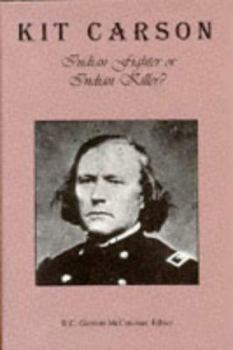
Kit Carson: Indian Fighter or Indian Killer?

This volume brings together a distinguished group of contributors who explore the latest historical research on Carson, one of the most widely revered and famous of America's frontier heroes. This description may be from another edition of this product.
Format:Hardcover
Language:English
ISBN:0870813935
ISBN13:9780870813931
Release Date:January 1996
Publisher:Univ Pr of Colorado
Length:105 Pages
Weight:0.10 lbs.
Dimensions:9.5" x 0.5" x 6.5"
Customer Reviews
1 rating
Presentism Fails Again
Published by Thriftbooks.com User , 18 years ago
In the historical profession the term "Presentism" denotes writing a history book or article using the values of the present to judge the events of the past. For instance, apologists for the Confederacy--called neo-Confederates--have attempted to rewrite Civil War history. They attempt to prove--from their modern perspective--that slavery was wrong and had nothing to do with the outbreak of the Civil War because the "noble" leaders of the Confederacy could not have fought for so evil a cause. Much better to claim that they fought for states rights. Similar attitudes damn Presidents Washington and Jefferson for holding slaves despite the fact that abolition was an idea that had barely appeared in the American consciousness of their time. Similarly, other "presentists" damn the whites for taking land from the Indians at a time when taking land from aboriginal inhabitants any where in the world was then the norm. One wonders what sins our generation will be condemned for two or three centuries in the future because we did not have the wisdom to see that far ahead. In this vein, R.C. Gordon-McCutchan, as editor of "Kit Carson: Indian Fighter or Indian Killer" has collected essays from modern scholars who have done their best to place Carson in his correct time and place. In short these authors have tried to let Carson live by the standards of the mid-19th Century rather than those of the 20th (the book was published in 1996). Carson lived in a time and place where, since 1607, the Navajo raided first the Spanish, then Mexicans and finally the Americans. During this long period the Navajo also raided the resident Hopi, Pueblo, and Zuni, whose urban-agricultureal life produced a wealth worth stealing. There is some irony in the fact that both the archaeological and historical evidence clearly shows the Navajo were themselves invaders of the area. The Americans were simply another group to raid as were any other non Navajos of the area. Kit Carson, as a man of the 19th Century, was in reality just carrying on an established pattern, and he did it, according to the research in this book, in a remarkably--for the time-- humane manner. The Navajo rendidtions of his cruelty are mainly, according to this book, legends that were spawned in the 1970 through the 1990s. They were not part of the Navajo opinion of the 1860s, Timothy R. Roberts Ph.D (Univesity of Missouri 1976)
Copyright © 2026 Thriftbooks.com Terms of Use
| Privacy Policy | Do Not
Sell/Share My Personal Information | Cookie Policy | Cookie Preferences | Accessibility Statement
ThriftBooks® and the ThriftBooks® logo are registered trademarks of Thrift Books Global, LLC
ThriftBooks® and the ThriftBooks® logo are registered trademarks of Thrift Books Global, LLC
