


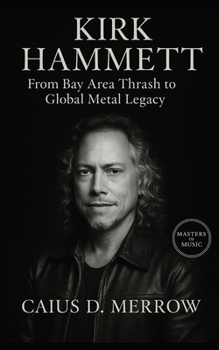
Kirk Hammett: From Bay Area Thrash to Global Metal Legacy
No Customer Reviews

Write in the tone of The Historian in the Front Row. Speak with the authority of a seasoned music historian whose bylines in Mojo, Rolling Stone, and The Wire carry weight. Every sentence must project confidence of fact-names, dates, venues, studios-while avoiding pedantry. Readers must trust reliability; where evidence is contested, acknowledge the limits by distinguishing corroborated detail from debated accounts. Structure chapters like album tracks: some explosive and high-energy (seminal concerts, breakthrough albums, clashes, headline-grabbing tours), others stripped-down and reflective (childhood, addictions, studio craft, long silences). Write with novelistic pacing, scene-by-scene and character-by-character, recreating events with sensory detail rather than simply listing them. Use contextual layering to situate the artist inside wider currents: local scenes, political climates, record label economics, technological shifts. Blend micro detail (amps, outfits, studio gear) with macro forces (MTV, Napster, Spotify). Because research draws on GPT-5, synthesize multiple sources, and flag contradictions when they appear.
Humanize legends without melodrama. Show fragility, humor, and tension alongside triumphs and failures. Keep the chaos intact rather than polishing it away. Write as if you had insider access to the rehearsal room but maintain the clarity of an outsider historian. Expose the machinery behind music-contracts, labels, venues, networks-so readers understand not just what happened, but why. Approach the work as cultural anthropology: treat each artist as a node in a network of collaborators, venues, labels, zines, and movements. Describe grunge, Britpop, nu-metal, DIY punk, or stadium rock as ecosystems shaping and shaped by the artist. Build scenes with sensory anchors: the hum of amps, cigarette smoke in basements, the echo of arenas, the smell of cramped vans. Put the reader in the room. Follow non-negotiables: no filler, no blind fan-service, no speculation without signal. Every line must add clarity, context, or energy. Humanize without hagiography. Each sentence should either give readers visceral immediacy or deeper cultural understanding. The result should feel like reading a definitive magazine profile expanded across 300 pages-intimate, authoritative, cinematic, and cultural.
Humanize legends without melodrama. Show fragility, humor, and tension alongside triumphs and failures. Keep the chaos intact rather than polishing it away. Write as if you had insider access to the rehearsal room but maintain the clarity of an outsider historian. Expose the machinery behind music-contracts, labels, venues, networks-so readers understand not just what happened, but why. Approach the work as cultural anthropology: treat each artist as a node in a network of collaborators, venues, labels, zines, and movements. Describe grunge, Britpop, nu-metal, DIY punk, or stadium rock as ecosystems shaping and shaped by the artist. Build scenes with sensory anchors: the hum of amps, cigarette smoke in basements, the echo of arenas, the smell of cramped vans. Put the reader in the room. Follow non-negotiables: no filler, no blind fan-service, no speculation without signal. Every line must add clarity, context, or energy. Humanize without hagiography. Each sentence should either give readers visceral immediacy or deeper cultural understanding. The result should feel like reading a definitive magazine profile expanded across 300 pages-intimate, authoritative, cinematic, and cultural.
Format:Paperback
Language:English
ISBN:B0FPFV6BB8
ISBN13:9798263258283
Release Date:September 2025
Publisher:Independently Published
Length:136 Pages
Weight:0.31 lbs.
Dimensions:0.3" x 5.0" x 8.0"
Customer Reviews
0 rating
Copyright © 2025 Thriftbooks.com
Terms of Use | Privacy Policy | Do Not Sell/Share My Personal Information | Cookie Policy | Cookie Preferences | Accessibility Statement
ThriftBooks ® and the ThriftBooks ® logo are registered trademarks of Thrift Books Global, LLC
ThriftBooks ® and the ThriftBooks ® logo are registered trademarks of Thrift Books Global, LLC
