


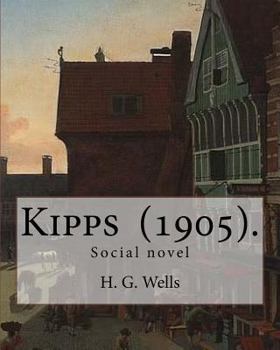
Kipps (1905). By: H. G. Wells: Social novel


Select Format
Select Condition 
Book Overview
Kipps: The Story of a Simple Soul is a novel by H. G. Wells, first published in 1905. Humorous yet sympathetic, the perceptive social novel is generally regarded as a masterpiece, and it was his own favourite work Plot: The protagonist of the Bildungsroman is Arthur "Artie" Kipps, an illegitimate orphan. In Book I ("The Making of Kipps"), he is raised by his aged aunt and uncle, who keep a little shop in New Romney, on the southern coast of Kent. He attends the Cavendish Academy ("a middle-class school", not a "boarding school", ) in Hastings, in East Sussex. "By inherent nature he had a sociable disposition", and befriends Sid Pornick, the neighbour's boy. Kipps falls in love with Sid's younger sister, Ann. Ann gives him half a sixpence as a token of their love when, at 14, he is apprenticed to the Folkestone Drapery Bazaar, run by Mr. Shalford. However, the Pornicks move away and Kipps forgets Ann. He becomes infatuated with Helen Walshingham, who teaches a wood carving class on Thursday nights. When Chitterlow, an actor and aspiring playwright, meets Kipps by running into him with his bicycle, their encounter turns into an inebriated evening that leads to Kipps being "swapped" (dismissed). However, before he leaves Mr. Shalford's establishment, Chitterlow brings to his attention a newspaper advertisement that leads to an unsuspected inheritance for Kipps from his grandfather of a house and 26,000. In Book II ("Mr. Coote the Chaperon"), Kipps fails in his attempt to adapt to his new social class while he lives in Folkestone. By chance, he meets a Mr. Coote, who undertakes his social education; that leads to renewed contact with Helen Walshingham, and they become engaged. However, the process of bettering himself alienates Kipps more and more, especially since Helen has takes advantage of Kipps's fortune to establish herself and her brother in London society. Chance meetings with Sid and then Ann, now a house servant, lead to a decision to abandon ..................... Herbert George Wells (21 September 1866 - 13 August 1946), usually referred to as H. G. Wells, was an English writer. He was prolific in many genres, writing dozens of novels, short stories, and works of social commentary, satire, biography, and autobiography, including even two books on war games. He is now best remembered for his science fiction novels and is often called a "father of science fiction", along with Jules Verne and Hugo Gernsback. During his own lifetime, however, he was most prominent as a forward-looking, even prophetic social critic who devoted his literary talents to the development of a progressive vision on a global scale. A futurist, he wrote a number of utopian works and foresaw the advent of airplanes, tanks, space travel, nuclear weapons, satellite television and something resembling the World Wide Web. His science fiction imagined time travel, alien invasion, invisibility, and biological engineering. Brian Aldiss referred to Wells as the "Shakespeare of science fiction". His most notable science fiction works include The Time Machine (1895), The Island of Doctor Moreau (1896), The Invisible Man (1897), and The War of the Worlds (1898). He was nominated for the Nobel Prize in Literature four times. Wells's earliest specialised training was in biology, and his thinking on ethical matters took place in a specifically and fundamentally Darwinian context. He was also from an early date an outspoken socialist, often (but not always, as at the beginning of the First World War) sympathising with pacifist views. His later works became increasingly political and didactic, and he wrote little science fiction, while he sometimes indicated on official documents that his profession was that of journalist....
Format:Paperback
Language:English
ISBN:1717388191
ISBN13:9781717388193
Release Date:April 2018
Publisher:Createspace Independent Publishing Platform
Length:202 Pages
Weight:0.91 lbs.
Dimensions:0.4" x 8.0" x 10.0"
Customer Reviews
2 ratings
Brilliantly witty, highly entertaining novel.
Published by Thriftbooks.com User , 19 years ago
Kipps was my first excursion into the (very large) world of non-science fiction Wells. Before I received this novel for Christmas, I had never even known that Wells wrote books other than sci-fi. I was already impressed with the well-known books of Wells, such as the Time Machine, War of the Worlds, etc., and was excited to read something of his other works. Kipps is the story of a lower-class young man who finds out that he has been left a great deal of wealth. With this acquisition, he begins the struggle to learn how to live in the upper-class. Many humorous events take place, as he tries his best to avoid society, and when forced to face it, stumbles and embarrasses himself considerably. Through it all, though, we see a struggling and not-too-smart man doing his best to live a fulfilling life - and learning what it really means to be satisfied. Wells writing style here is brilliant, filled with a distinctively British humor that I learned to love watching old episodes of Jeeves and Wooster. The characters, their dialog, and the narrator all add to the excellently portrayed humor. Humor is not the only aspect which makes this novel so great. The very believable plot, with its startling twists and turns, is captivating. At times I nearly wanted to turn ahead in the book to find out what was to happen next. Wells has a tormenting way of hinting about what will happen next, without revealing anything, so that the suspense is heightened even more. I never found the book boring or dry, but always very interesting. Near the end of the book I encountered a very different passage which deviated from the humor and made a very serious and relevant point. The book's introduction seems to say that this passage nearly ruins the book, but in my opinion it only strengthens the book and deepens its meaning. If you have yet to experience this side of Wells, I highly encourage you to do so. Not only will you experience the great wit of his, but also his wonderfully British writing style and his interesting points about society which still apply today. 5 stars, through and through.
Not the scifi Mr. Wells is better known for
Published by Thriftbooks.com User , 28 years ago
H. G. Wells is best known for "War of the Worlds" and "The Time Machine", 2 groundbreaking, classic science fiction titles. But "Kipps: The Story of a Simple Soul" is a heart-warming account of a young man suddenly thrown into a higher class and managing to eventually marry his childhood sweetheart and live out a dream. I really enjoyed this book, and the main characters stayed with me, and the events became my own experiences. I can vividly remember sipping a cappucino when Kipps met Chitterlow. I remember the song playing on the radio when Kipps heard what Walshingham had done. And I remember the rain outside when it was clarified why the story had a narrator that was not involved in the story itself. Yes, this is truly a 'feel-good' novel that will stay with me for a long time, and I recommend it to anyone who likes to just sit down and read, and meet likeable characters, without a lot of tech talk, gory action and confusing subplots. Don't pass this one up
Copyright © 2026 Thriftbooks.com Terms of Use
| Privacy Policy | Do Not
Sell/Share My Personal Information | Cookie Policy | Cookie Preferences | Accessibility Statement
ThriftBooks® and the ThriftBooks® logo are registered trademarks of Thrift Books Global, LLC
ThriftBooks® and the ThriftBooks® logo are registered trademarks of Thrift Books Global, LLC
