


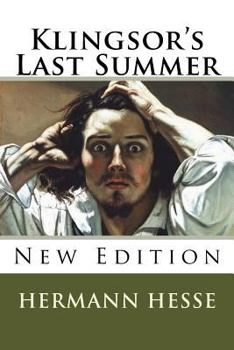
Klingsor's Last Summer

Select Format
Select Condition 
Book Overview
Klingsor's Last Summer tells the story of a famous painter named Klingsor as he experiences a final burst of creativity in his last summer of life. He grabs the cup of life with both hands and drinks until he simply cannot take any more. Klingsor is an expressionist painter ruled by emotion, his commitment to art is total, for art is the embodiment of what he feels to be the essence of life. Klingsor's most prominent traits are his love of extremes. As a person he is violently opposed to moderation or mediocrity. He burns the candle at both ends and shuns the safety of moderation. Klingsor is very much a man of the moment. He does not like to plan ahead in any way. He does not believe in tomorrow and he regards every day as his last. Klingsor's two primary interests in life are creating art and making love and he succeeds in both endeavors. Like Demian, Siddhartha, Goldmund, and Joseph Knecht, Klingsor is no ordinary person. He has attained a remarkable degree of success in his chosen field and he works intensely to maintain this level of achievement. Like other Hesse's heroes, Klingsor seeks and finds his own unique and independent path to fulfillment. The style of the story is expressionist, it conveys a feeling of exuberance and excitement. The imagery is wild and colorful. The reader feels transported to Klingsorr's side as he attempts to embrace the wonders of life and nature with his entire being, only to accept that his time is nearly up. The novel is somehow autobiographical, Hesse began painting around 1917 and Klingsor's Last Summer was written in the summer of 1919, the novel is a more direct self-portrait of the Hesse of that year when Hesse settled in the Ticino mountain village of Montagnola to start a new life without his wife and children. Some of the characters have relevance to Hesse's real life. Hermann the poet could be a self reference and Louis was modeled on Hesse's artist friend Louis Moilliet. Klingsorr, the name, is taken from the magician who appears in Richard Wagner's opera Parsifal.
Format:Paperback
Language:English
ISBN:1530647444
ISBN13:9781530647446
Release Date:March 2016
Publisher:Createspace Independent Publishing Platform
Length:78 Pages
Weight:0.65 lbs.
Dimensions:0.2" x 6.0" x 9.0"
Related Subjects
Creativity Isolation Love Memory Paintings Literary Fiction Classics Contemporary Fiction HistoryCustomer Reviews
3 ratings
a story by story run-through of the collection
Published by Thriftbooks.com User , 22 years ago
CHILD'S SOUL: Hesse is largely an autobiographical author. Even when events in his novels or stories took place in the distant past or in the fantastically created future, he wrote about what he had lived through. His renowned novel "Demian" is very much autobiographical. The story "Child's Soul" may be the only thing ever written by Hesse, which is more autobiographical than "Demian". The narrating person in "Child's Soul" does not have a mental equilibrium. He can not draw a line between good and evil, between love and destruction; his mental state is characterized by fear. Nonetheless, he only sees the "chaos" and takes its existence into consideration. His future fate is unknown, but there we see a sparkle of hope that he will gain a foot-hold and achieve the state of mental equilibrium. PS: the term "chaos" was used by Hesse himself in one of his articles. [Rating: 5/5] KLEIN AND WAGNER: An uxoricide and a filicide escapes from Germany to Italy to find peace for his tormented soul. He finds there death, however. Unlike the narrating person in the story described above, here we know for sure that Klein self-destructs. This story, especially, is laden with philosophical passages. Here (and in the story described bellow, as well) we see how Hesse uses associations; "klein" is the German adjective that stands for "small" and Wagner is not only the name of another uxoricide and filicide, but also that of a famous composer, whose music is tied in Klein's imagination with eroticism of his youth. [Rating: 5/5] KLINGSOR'S LAST SUMMER: a story of a dying painter, who, as we know from the preface, is only forty-two years old. In this case, the name Klingsor comes from one epic poem that dates back to the seventh century. In that poem Klingsor was a magician, which suggest some sort of kinship between the art and the magic. This particular story is somewhat ambiguously written, even Klingsor's death remains ambiguous. One can not say with a certainty whether Klingsor committed a suicide, even though the whole mood of this story is imbued with ideas of life's frailty and death's imminence. This ambiguous narration (which Hesse employed in many of his works) does capture the atmosphere in which Klingsor spent his last days (and perhaps most of his life), but it bears a mark of abstractness. [Rating: 4/5]
Mind Triptych
Published by Thriftbooks.com User , 23 years ago
fascinating, luscious stories filled with spiritual and debaucherous intrigues of the most unexpected sorts.Hesse waves tales infused with rich mythological imagery and interesting turns around every corner.Three stories that run the gamut from romanticism to melancholy.Always a mystery and forever a joy.
More of Hesse?s beautiful spirituality
Published by Thriftbooks.com User , 24 years ago
Not one review of this book! Incredible, you don't know what you're missing if you have not read this author. This is not one of the most recognized works of the Nobel prize author (my personal favorite), but it has everything of what made their other novels so remarkable: the beautiful and deep description of his characters' thoughts and emotions.This edition contains three stories: "Child's soul", "Klein and Wagner" and "Klinsor's last summer" The first one succeeds in showing how intense a child's feelings can be, the happiness and sadness that can be reached while being so young, how a small mistake can trigger the biggest of fears... Klein and Wagner, for me the best one of this book. And "Klingsor's last summer" the story of an artist who is dying, while reading this you become Klingsor...I wonder how could Hesse succeed to such degree in portraying thoughts and feelings, no other existentialist author I've read so far reached this complexity.
Copyright © 2026 Thriftbooks.com
Terms of Use | Privacy Policy | Do Not Sell/Share My Personal Information | Cookie Policy | Cookie Preferences | Accessibility Statement
ThriftBooks ® and the ThriftBooks ® logo are registered trademarks of Thrift Books Global, LLC
ThriftBooks ® and the ThriftBooks ® logo are registered trademarks of Thrift Books Global, LLC
