
Skip to content
Scan a barcode
Scan
Paperback Kingdom Come (P.S.) Book

ISBN: 0007232470

ISBN13: 9780007232475

Kingdom Come (P.S.)

Select Format

Select Condition ThriftBooks Help Icon

Recommended

Format: Paperback

Condition: Good

$11.69
Save $4.26!
List Price $15.95
Almost Gone, Only 1 Left!
Save to List

Book Overview

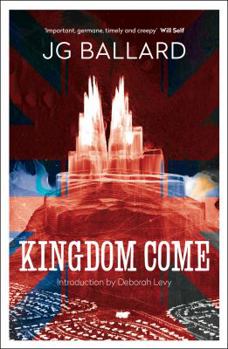
With a new introduction by Deborah Levy and a striking new cover design by the artist Stanley Donwood, Ballard's final novel sees consumerism evolve into something even more sinister.

A gunman opens fire in a shopping mall. Not a terrorist, apparently, but a madman with a rifle. Or not, as he is mysteriously (and quickly) set free without charge.

One of the victims is the father of Richard Pearson, unemployed advertising executive and life-long rebel. Now he is driving out to Brooklands, the apparently peaceful town on the M25 which has at its heart the very shiny shoppers' paradise where the shooting happened - the Metro-Centre.

Then the main suspect is released - thanks to the testimony of self-styled pillars of the community like the doctor who treated Richard's father on his deathbed. Richard, determined to unravel the mystery, starts to believe that something deeply sinister lurks behind the pristine facades of the labyrinthine mall, its 24-hour cable TV and sports club...

Customer Reviews

2 ratings

The Fascim of Consumerism

Over the years, JG Ballard has often written about inner space and psychology. With his last fiction novel, KINGDOM COME, he's finally moved from having his main character be the observer of someone influencing the social change and breakdown to being the one who is orchestrating it. When Richard Pearson first comes to the town of Brooklands and its shopping Metro-Centre, he's trying to discover who was the shooter behind the mall rampage that killed his father. But after the main suspect is released, Pearson begins to investigate the town leaders and the 24-hour mall itself, finding a strange and lurking culture of consumerism and sports clubs. The more he tries to understand and disassemble it, the more he becomes a part of the expanding and unraveling dystopia.

Ballard's most evocative for years

Kingdom Come By J.G. Ballard 4th Estate/Harper Collins In his astonishing new novel J.G. Ballard has discovered the apocalypse in the form of washing machines, stereo units and every other form of what his characters have dubbed, with both political and religious fervour, Consumerism. Ballard's novels have often touched a nerve, from his erotic-schizoid Crash to his semi-autobiographical The Empire of the Sun. Much of his earlier work was decidedly fantastical and often generically dubbed science fiction. But in his recent novels Ballard has been investigating the present. Often dubbed a Futurist, his conclusions are unnerving indeed. In some ways Kingdom Come is a return to form for Ballard. His three previous novels - Cocaine Nights, Super-Cannes, Millennium People - seemed somewhat anchored by his attempts to grapple the strangeness of contemporary suburban life. But in Kingdom Come Ballard is both terrifyingly insightful and at his most phantasmagorical best. Kingdom Come in its 280 pages seems to achieve a strangely heroic, epic scale. In essence it is the story of a rather ineffectual, unemployed advertising executive, Richard Pearson. But when Pearson's father is murdered in a labyrinthine shopping mall in suburban Brooklands near the Heathrow Airport he sets out to investigate why the initially accused shooter has been set free. Thus begins a surreal journey into the heartlands of English suburbia, thuggish sports riots, racism, terrorism, hostage-taking, contemporary politics, consumer greed, religious extremism, family relations and far more. Where Kingdom Come succeeds is in its fine high-wire act of balancing pure farce, surreal imagery and real world events. One suspects that Ballard, who lives in suburban Shepparton outside of London, may have personally witnessed some of the racist attacks that have become commonplace during soccer riots; he depicts the senseless vandalism and violence with solemn clarity. He is equally acute in describing the culturally void environs in which such violence occurs. His satellite suburbs are essentially devoid of, libraries, art galleries or traditional places of worship. His Brookland is dominated by a central grand edifice, a vast shopping mall dubbed the Metro-Centre, the site of what he comes to believe is his father's deliberate assassination. Brooklands has become dominated by the semi-martial football gangs. The populace wear clothing adorned with the cross of Saint George, without which one is invariably a target of the hooligans. Ballard's tale builds powerfully as Pearson's paranoia grows apace, leading to a hostage situation replete with a virulent form of Stockholm Syndrome. On the wild ride we encounter many of Ballard's favourite tropes and his increasing tendency towards self-referentiality. Pearson's father was an airline pilot, leading to riffs reflecting Ballard's fascination with flight - "a reverie of wings that overflew deserts and tropical estuaries" - references to hi
Copyright © 2026 Thriftbooks.com Terms of Use | Privacy Policy | Do Not Sell/Share My Personal Information | Cookie Policy | Cookie Preferences | Accessibility Statement
ThriftBooks ® and the ThriftBooks ® logo are registered trademarks of Thrift Books Global, LLC

GoDaddy Verified and Secured