


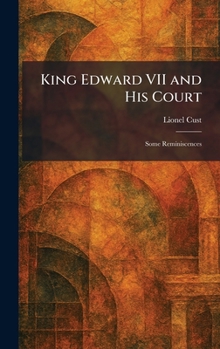
King Edward VII and His Court: Some Reminiscences

Select Format
Select Condition 
Book Overview
"King Edward VII and His Court; Some Reminiscences" offers an intimate and authoritative look at the British monarchy during a transformative period in history. Written by Lionel Cust, a distinguished courtier and art historian who served closely under the King, this work provides first-hand accounts of the inner workings of the royal household. Cust details the vibrant personality of Edward VII, capturing the essence of a monarch who sought to modernize the British court while maintaining its traditional prestige.
The narrative explores the social nuances, diplomatic shifts, and daily life within the palace walls, transitioning from the long, somber reign of Queen Victoria into the more gregarious and cosmopolitan Edwardian era. Readers are granted a unique perspective on the King's interactions with prominent figures of the time, his dedication to the arts, and the intricate etiquette that defined early 20th-century high society. Through these vivid reminiscences, the work serves as an invaluable historical document for those interested in the British royal family, the complexities of court life, and the enduring legacy of one of Britain's most charismatic rulers.
This work has been selected by scholars as being culturally important, and is part of the knowledge base of civilization as we know it. This work was reproduced from the original artifact, and remains as true to the original work as possible. Therefore, you may see the original copyright references, library stamps (as most of these works have been housed in our most important libraries around the world), and other notations in the work.
This work is in the public domain in the United States of America, and possibly other nations. Within the United States, you may freely copy and distribute this work, as no entity (individual or corporate) has a copyright on the body of the work.
As a reproduction of a historical artifact, this work may contain missing or blurred pages, poor pictures, errant marks, etc. Scholars believe, and we concur, that this work is important enough to be preserved, reproduced, and made generally available to the public. We appreciate your support of the preservation process, and thank you for being an important part of keeping this knowledge alive and relevant.
Customer Reviews
ThriftBooks ® and the ThriftBooks ® logo are registered trademarks of Thrift Books Global, LLC
