


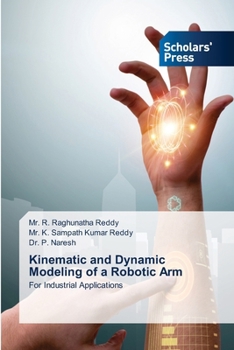
Kinematic and Dynamic Modeling of a Robotic Arm
No Customer Reviews

For Industrial ApplicationsThis study focuses on developing accurate kinematic and dynamic models of a robotic arm to enhance its performance in industrial settings. Kinematic modeling involves defining the motion of the robotic arm's joints and end-effector without considering forces, using techniques like Denavit-Hartenberg parameters for forward and inverse kinematics. Dynamic modeling incorporates forces and torques acting on the arm, applying Newton-Euler or Lagrangian methods to optimize performance under varying loads. These models enable precise motion planning, control, and efficiency in tasks such as assembly, welding, and material handling, ensuring reliability and adaptability in industrial automation.
Format:Paperback
Language:English
ISBN:3639718569
ISBN13:9783639718560
Release Date:July 2025
Publisher:Scholars' Press
Length:52 Pages
Weight:0.18 lbs.
Dimensions:0.1" x 6.0" x 9.0"
Customer Reviews
0 rating
Copyright © 2026 Thriftbooks.com
Terms of Use | Privacy Policy | Do Not Sell/Share My Personal Information | Cookie Policy | Cookie Preferences | Accessibility Statement
ThriftBooks ® and the ThriftBooks ® logo are registered trademarks of Thrift Books Global, LLC
ThriftBooks ® and the ThriftBooks ® logo are registered trademarks of Thrift Books Global, LLC
