


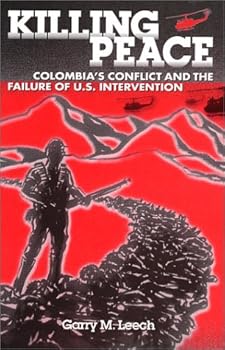
Killing Peace: Colombia's Conflict and the Failure of U.S. Intervention

Over the past half-century, Colombia has been plagued by violence—its people caught in the middle of a civil conflict raging between the army, leftist guerrillas, right-wing paramilitaries,... This description may be from another edition of this product.
Format:Paperback
Language:English
ISBN:097203840X
ISBN13:9780972038409
Release Date:April 2002
Publisher:Information Network of the americas
Length:116 Pages
Weight:0.30 lbs.
Dimensions:5.0" x 7.8"
Customer Reviews
5 ratings
A good introduction...worth buying
Published by Thriftbooks.com User , 21 years ago
Killing Peace is a good introduction to the forty year civil war in Colombia. (Arguably the civil war began in the 1940s. The 1960s represent the date the rebel forces FARC emerged.) Leech provides objective descriptions of the history of the conflict, the social forces and striking class divisions generating it, how the USA's imperialist interests and interventions aggravate it, the civil war's principal players and fighting forces, the widespread human rights abuses that debase the conflict, the criminal activities employed to finance it, and the many failed military and peace approaches to resolve it. I particularly appreciated Leech's analysis of the rise and role of the right-wing paramilitaries in Colombia, the staggering degree of homelessness and poverty created by the USA's "fumigation" program, and the USA's use of (what should be frankly coined) corporate mercenaries in the war. Although FARC is the largest fighting rebel force in Colombia, I wish Leech would have provided more information about the ELN. But, in this respect, Killing Peace is like most works on the Colombian civil war. My chief issue with the book, and others like it, is that it tends to analyze the prospects for resolving the conflict in terms of some equitable and just accommodation among the principal players (except for the paramilitaries). But that's precisely the problem with this civil war: given the nature and extent of their human rights violations (including assassination, mass murder, terror, kidnapping, extortion, drug trafficking, etc.), it is doubtful the principal players are capable of fashioning and maintaining an equitable and just settlement. The book doesn't satisfactorily look at other options. For example, the prospects for a resolution coming from the various social movements within Colombia as well as how other Latin American regional powers and interests could be brought to bear on the conflict. Perhaps that hope is too thin for Leech, but it could very well be the only one available.
A Grassroots View of the Violence in Colombia
Published by Thriftbooks.com User , 23 years ago
"Killing Peace" is an outstanding book. Garry Leech provides a front row seat to the surreal violence in Colombia. Moreover, he explains why a just and enduring peace is so difficult to attain. The author is a superb journalist who documents how the flames of peace have been doused and the drums of war have been amplified. Recommended.
short, clear intro to an important and confusing conflict
Published by Thriftbooks.com User , 23 years ago
Leech has done the confused observer of Colombia's tragedy a great service with this short, pocket-sized introduction to the reality behind the sporadic news reports on Latin America's most violent, dysfunctional country. The book provides a clear and concise history of modern Colombia with particular emphasis on the causes of the armed conflict that has raged there for decades. Leech examines Colombia's civil war and how it differs from yet is intertwined with the drug war, while avoiding the common pitfall of completely muddling the two topics.The book also traces the gradual U.S. entry into the fray of the Colombia's conflict, from early forays into combatting marijuana production to the current strategy that closely resembles Reagan-era strategies in El Salvador, albeit with the additional complication of Colombia being a leading cocaine and heroin supplier. Leech's answer to the uncomfortable question, "Is the drug war working?" is an emphatic "No." He explains how the U.S. drug war is failing on all of its own terms, while at the same time detailing the disastrous human toll of increased U.S. aid to the undisciplined and extremely compromised Colombian military. The role of the various guerrilla and paramilitary groups is explained, and there are also interesting new insights into the relations between the Colombian army and the rightist paramilitaries.This book should be of particular use to those who seek to quickly learn more about the country and conflict that are fast becoming one of the primary U.S. foreign policy concerns. Its brevity and breadth should prove especially appropriate for high school and college classes focusing on current events, foreign policy, Latin American affairs, and history. A good, short read on a truly important topic.
KILLING PEACE is a quick, concise must-read
Published by Thriftbooks.com User , 23 years ago
To my mind, the expanding civil war in Colombia is the biggest story in the Western Hemisphere -- but no one seems to be paying much attention to it. Good thing, then, that we have Garry Leech, a talented reporter and writer whose book explains it all, from the start of the trouble over fifty years ago to the U.S.'s involvement today with more and more money, guns, and soldiers. If George Bush gets his way, Colombia is going to be the next bloody battle in the "war on terrorism." Americans need to get wise to what's going on before we sink any deeper into Colombia and a world of hurt and regret. Step one: Read this book!
Now I understand
Published by Thriftbooks.com User , 23 years ago
This book satisfied my need for a clarification of the conflicts in Colombia. Leech does an amazing job of simplifying this political quagmire.
Copyright © 2026 Thriftbooks.com
Terms of Use | Privacy Policy | Do Not Sell/Share My Personal Information | Cookie Policy | Cookie Preferences | Accessibility Statement
ThriftBooks ® and the ThriftBooks ® logo are registered trademarks of Thrift Books Global, LLC
ThriftBooks ® and the ThriftBooks ® logo are registered trademarks of Thrift Books Global, LLC
