


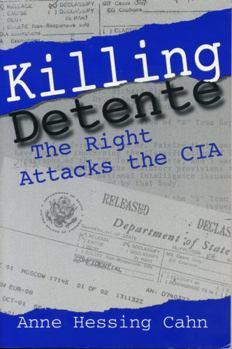
Killing Detente: The Right Attacks the CIA

Select Format
Select Condition 
Book Overview
A detailed account of a major episode of intelligence intervention in politics in the mid-1970s.
Format:Paperback
Language:English
ISBN:0271017910
ISBN13:9780271017914
Release Date:August 1998
Publisher:Penn State University Press
Length:246 Pages
Weight:0.30 lbs.
Dimensions:9.0" x 0.8" x 6.0"
Customer Reviews
4 ratings
..too much blessings from Detente...
Published by Thriftbooks.com User , 18 years ago
Sadat and the Syrians officially informed Moscow about their intention to strike at Israel and they take, this time, the initiative to attack. The signatories of Détente saw this as a mere prelude to a political solution. The Russians and the Americans knew the Arabs did not want to destroy Israel, nor were they capable of doing so; they simply wanted to break the stalemate that was ending in a deadlock and lasted for a long time. The situation had become intolerable since the end of the Six Days war of 1967. Six years later, the Arabs, independently and without USSR's energetic guidance, realized that without some shock treatment neither the Israeli nor the Americans would be willing to move and find a settlement (instead of a solution) to this deadlock. Sadat's presentation almost certainly met with Soviet approval. Day by day the local media assured the Arabs that Soviet leaders had often stressed the necessity of a just and fair political solution to the conflict. Nobody ever wrote about a just and fair settlement of the conflict that started from the beginning of the twentieth century. Brezhnev gave a speech at Alma-Ata that can rightfully be regarded as a roadmap. He concluded the following among the most urgent tasks the USSR had to discuss with friends ""The achievement of a political settlement in the Middle East on the basis of the declaration of U.N. Security Council and General Assembly that provides for the withdrawal of Israeli troops from all occupied Arab lands"" . The Arab Left saw this was the Communist Party line and the statement was reiterated in many speeches and articles up to the outbreak of the 1973 war. Arab radios repeatedly voiced Soviet leaders that it was unacceptable to acquire territory by force - unless of course the country in question happened to be a superpower such as the Soviet Union. In 1971, within the context of `détente', USA and USSR signed agreement to sell $ 136 million wheat and $ 125 million drilling equipment to Russia i.e. to export surplus American wheat to USSR. In return, Brezhnev agreed to help Nixon push North Vietnam to negotiate end of the war and Nixon began trade with Russia, sale of wheat, Siberian Gas investment. (Just a marginal observation in this context: Senator Henry Jackson led passage of Jackson-Vanik amendment to withhold most favored nation status until Russia allowed unlimited Jewish emigration and guaranteed human rights) So,and still within the context of detente, when the Arab Oil Producers decided at their meeting in September 1973 to use the Oil weapon, Pravda encouraged them and expressed hope that oil warfare would escalate. The Arabs Right (then labeled ""Reactionaries"" by their `'brothers" of the Left, saw this as a venue for Moscow to benefit from any consequential increase in the price of Oil). In fact the Soviets were then suffering from severe shortage of wheat. The price of bread was much below the cost of the wheat used to produce it. Russia simply subs
3 book reviews
Published by Thriftbooks.com User , 20 years ago
Killing Detente: The Right Attacks the CIA; Review; book reviews Bulletin of the Atomic Scientists January, 1999 No. 1, Vol. 55; Pg. 70 Warnke, Paul C. Killing Detente is a highly readable account of an ill-considered and maladroit exercise in intelligence reassessment that delayed--but did not derail--detente, the process of accommodation that occurred between Washington and Moscow in the mid-1970s. In presenting her analysis of what became known as the Team B exercise, Anne Cahn uses her extensive experience in international affairs, a careful review of many previously unavailable documents, and interviews with key individuals involved in the affair. (I should disclose that I worked with the author at the Arms Control and Disarmament Agency and the Committee on National Security, and reviewed drafts of some chapters of her book.) Shortly after Gerald Ford succeeded Richard Nixon, the President's Foreign Intelligence Advisory Board (PFIAB) began to push for an alternative review of Soviet strategic capabilities, contending that the National Intelligence Estimates prepared by the Central Intelligence Agency (CIA) might be understating Soviet strategic strength. Competent analysts, however, had criticized the CIA's reports as greatly overstating Soviet military expenditures. In late 1975, then-CIA Director William Colby responded negatively to the PFIAB proposal and disagreed with its contention that the agency's intelligence estimates erred by "projecting a sense of complacency." But President Ford, engaged as he was with Ronald Reagan's challenge for the 1976 Republican presidential nomination, was sensitive to possible fight-wing criticism. He eventually authorized the Team B adventure. The initial idea was to appoint three panels of outside experts that would assess, respectively, the threat to U.S. ICBM survival created by Soviet missile accuracy, the Soviet anti-submarine warfare capability against U.S. nuclear missile submarines, and the extent to which Soviet air defenses could prevent penetration by strategic bombers. The navy, however, considered information about the operational aspects of submarine patrols and whether they might be trailed by Soviet assets as information that could not be shared, even with the CIA. The second panel, accordingly, was reoriented to deal with Soviet strategic objectives. It is the work of this panel that is generally referred to as the Team B Report. Whatever might be said for evaluation of strategic capabilities by a group of outside experts, the impracticality of achieving useful results by "independent" analysis of strategic objectives should have been self-evident. Moreover, the futility of the Team B enterprise was assured by the selection of the panel's members. Rather than including a diversity of views, as was recently done in putting together the, so-called Rumsfeld Commission on the ballistic missile threat, the Strategic Objectives Panel was composed entirely of individuals who had m
Take the time to read this one...you"ll be glad you did.
Published by Thriftbooks.com User , 27 years ago
This is a very readable, interesting book written on a topic that few of us as ordinary citizens have been informed about - yet it has impacted our security, our international policy and our financial future for decades to come!! I appreciated the author's efforts to speak directly with so many of those involved in the process at the time rather than relying solely on the declassified documents . The author's efforts to give a thorough and well rounded view of this episode in history make this one of those books that should be read by historians and lay-folk alike !! I recommend it highly.
An excellent description of a seminal event in history.
Published by Thriftbooks.com User , 28 years ago
Well written, easy to read, fascinating subject about efforts by conservatives to destroy detente between the US and the USSR in the mid-1970s. Interesting reading for students and laypersons. Cahn unearthed lots of formerly classified documents.
Copyright © 2026 Thriftbooks.com
Terms of Use | Privacy Policy | Do Not Sell/Share My Personal Information | Cookie Notice | Cookie Preferences | Accessibility Statement
ThriftBooks ® and the ThriftBooks ® logo are registered trademarks of Thrift Books Global, LLC
ThriftBooks ® and the ThriftBooks ® logo are registered trademarks of Thrift Books Global, LLC
