Skip to content
Scan a barcode
Scan
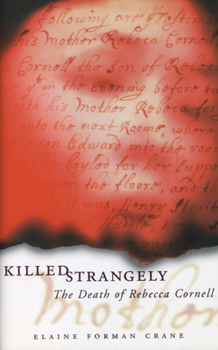
Hardcover Killed Strangely: The Death of Rebecca Cornell Book

ISBN: 0801440025

ISBN13: 9780801440021

Killed Strangely: The Death of Rebecca Cornell

Select Format

Select Condition ThriftBooks Help Icon

Recommended

Format: Hardcover

Condition: Like New

$55.69
Save $9.26!
List Price $64.95
Almost Gone, Only 1 Left!
Save to List

Book Overview

"It was Rebecca's son, Thomas, who first realized the victim's identity. His eyes were drawn to the victim's head, and aided by the flickering light of a candle, he 'clapt his hands and cryed out, Oh Lord, it is my mother.' James Moills, a servant of Cornell... described Rebecca 'lying on the floore, with fire about Her, from her Lower parts neare to the Armepits.' He recognized her only 'by her shoes.'"--from Killed Strangely

On a winter's evening in 1673, tragedy descended on the respectable Rhode Island household of Thomas Cornell. His 73-year-old mother, Rebecca, was found close to her bedroom's large fireplace, dead and badly burned. The legal owner of the Cornells' hundred acres along Narragansett Bay, Rebecca shared her home with Thomas and his family, a servant, and a lodger. A coroner's panel initially declared her death "an Unhappie Accident," but before summer arrived, a dark web of events--rumors of domestic abuse, allusions to witchcraft, even the testimony of Rebecca's ghost through her brother--resulted in Thomas's trial for matricide.

Such were the ambiguities of the case that others would be tried for the murder as well. Rebecca is a direct ancestor of Cornell University's founder, Ezra Cornell. Elaine Forman Crane tells the compelling story of Rebecca's death and its aftermath, vividly depicting the world in which she lived. That world included a legal system where jurors were expected to be familiar with the defendant and case before the trial even began. Rebecca's strange death was an event of cataclysmic proportions, affecting not only her own community, but neighboring towns as well.

The documents from Thomas's trial provide a rare glimpse into seventeenth-century life. Crane writes, "Instead of the harmony and respect that sermon literature, laws, and a hierarchical/patriarchal society attempted to impose, evidence illustrates filial insolence, generational conflict, disrespect toward the elderly, power plays between mother-in-law and daughter-in-law, [and] adult dependence on (and resentment of) aging parents who clung to purse strings." Yet even at a distance of more than three hundred years, Rebecca Cornell's story is poignantly familiar. Her complaints of domestic abuse, Crane says, went largely unheeded by friends and neighbors until, at last, their complacency was shattered by her terrible death.

Customer Reviews

5 ratings

I like it

I really enjoyed the book. It brought 17th century New England to life for me. I thank the authur for writing this and including history on other Cornells. I just bought a book about Sarah Cornell.

A forgotten murder mystery brought to light after 300 years

Killed Strangely: The Death of Rebecca Cornell is a fascinating true murder mystery by a Fordham University professor of history, chock full of early American criminal legends that from a less qualified source one might chalk up as fiction. In a single volume, she touches on two of New England's most infamous murder cases, and a third, the title case, which was strangely forgotten. At center stage in this gem of a book by Elaine Forman Crane is "one of New England's darker moments,"the death of the elderly Sarah Cornell in colonial Rhode Island in 1673. Weeks later, Thomas Cornell, her middle-aged son, was accused of her murder. But was she murdered at all? Sarah Cornell was an English settler and once was a follower and next-door neighbor of Anne Hutchinson when Hutchinson and family were massacred by Natives. How small was the colonial world. Mrs. Cornell escaped the slaughter - only to be cut down by her son years later. Or such was the verdict. Was old Sarah stabbed in her room, her body set on fire? Or did she die accidentally? One hopes it was indeed a case of murder since Thomas was hanged for it. The author lays out the evidence point by point and wrestles with the vagueness in the records, searching for answers, the final one elusive, but the exercise an enjoyable one. She did manage to unearth many fascinating depositions and transcripts from the case still in existence today, 340 years later, and they reveal the most intimate abuses and private aggressions in the Cornell family (which, much later, through more illustrious offspring, would found Cornell University). Thomas Cornell treated his mother very poorly, and the people who knew him very well, his friends and neighbors who judged him, determined that he killed her. How much weight should the guilty verdict be afforded? Who's to say? The legal process used to bring Thomas Cornell to the gallows was fascinating unto itself. The colonial court allowed a witness to testify that the dead woman's ghost visited him in a dream and made some vague allusion to her questioned death. Hearsay -- from a ghost. There is also a description of the "ordeal by touch," a quasi-legal procedure by which the accused was compelled to be in the presence of the deceased, and in a case of murder, bleeding from the corpse would give it away. And yet, despite these curious features of the law, Cornell was permitted an attorney and was not compelled to confess or testify against himself. Until this book came out, the story "languished in the shadows of historical obscurity," the author says. Amazingly, there was never a broadside, ballad, pamphlet, sermon, or other written record of the case beyond the legal papers. "The literary stillness," Crane says, "is all the more surprising since New Englanders enjoyed a good execution sermon or thrilling murder story." This book is what Id call popular criminology, a la the recent Science of Sherlock Holmes, though the academics would call it "microhistory".

CSI in Colonial Rhode Island

Professor Crane combines scholarly insights with an easy, narrative style and wit to make "Killed Strangely" a wonderful bridge between the academic world and that of the casual reader of historical novels. In this she joins the likes of David McCullough and Joanne Freeman to prove that history can be serious without having to be dull.Like a good crime scene investigator, Professor Crane unravels the details surrounding the death in February, 1673 of the elderly Rebecca Cornell, very possibly (but not necessarily)at the hands of her son, Thomas. But more than investigate the elements of a crime, she uses the skelton of Cornell's death and of Thomas' indictment and trial to create an understanding of the psychology and legal processes as well as the social and familial relationships of New England's Puritans and Quakers. We especially learn a lot about women, particulary elderly women, in the seventeenth century. At least part of an historian's role is to link the threads of history pointing out to us similarities and differences between eras. Crane traces one of those threads through the Cornell family into the nineteenth century. That raises all kinds of questions that extend beyond the scope of history into the realms of psychology, sociology and even genetics. Crane, thereby, points a flashlight into dark corners where we sometimes do not want to look. In this, she is reminiscent of "All God's Children," the account of New York's juvenile killer, Willie Bosket, and his ancestry by Fox Butterfield.Because we are of an era that believes in guilt "beyond a shadow of a doubt," we can be left unsatisfied by Thomas' conviction and execution as were, in fact, many of his contemporaries unfortunately for, his sake, posthumously. Crane addresses this in the chapter "Doubting Thomas: Or Considering the Alternatives." Unlike a tv show, history frequently cannot be neatly wrapped up in an hour and the plot sometimes does not end satisfactorily. But "Killed Strangely" is an easily recomended work whether you are a fan of the History Channel or Court TV --- or simply of Law and Order and CSI.

"Killed Strangely," a Fascinating Tale

"Killed Strangely" is a thoroughly engrossing tale of the extraordinary crime of matricide in 17th century New England. Crane's skills as an historian give the reader a vivid sense of the texture of everyday life in the Rhode Island colony as well as the legal standards and practices that determined the community's judgment. Although this is a work of non-fiction, the reader becomes involved with the characters' lives and the uncertainties surrounding the event in much the same way one does with a good novel. Highly recommended for anyone curious about the ways in which the country's past and present interconnect.

Fun and Interesting

I found this book to be quite a good and fun read. Of course it's hard to read this book against today's social back-drop but Elaine Forman Crane really took me back to the time period.Although the evidence is a bit scant - as is any from this time -Crane's conclusions are sound and well founded. I recommend this book with out reservation to all those interested in early American history and gender related history.
Copyright © 2026 Thriftbooks.com Terms of Use | Privacy Policy | Do Not Sell/Share My Personal Information | Cookie Notice | Cookie Preferences | Accessibility Statement
ThriftBooks ® and the ThriftBooks ® logo are registered trademarks of Thrift Books Global, LLC

GoDaddy Verified and Secured