


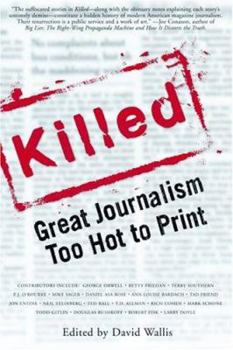
Killed: Great Journalism Too Hot to Print (Nation Books)


Killed resurrects remarkable articles that prestigious publications such as The New Yorker, the New York Times Magazine, Harper's, and Rolling Stone assigned to accomplished writers for sizeable fees,... This description may be from another edition of this product.
Format:Paperback
Language:English
ISBN:1560255811
ISBN13:9781560255819
Release Date:June 2004
Publisher:Nation Books
Length:352 Pages
Weight:1.20 lbs.
Dimensions:8.0" x 1.3" x 5.5"
Customer Reviews
3 ratings
Spiked
Published by Thriftbooks.com User , 19 years ago
I read very few non-fiction books, and most of them are histories. I DO read journalism every day. But this is a first in that I've just finished reading and am now reviewing an entire BOOK comprised solely of journalism---ahem, it was a Christmas gift. And, so, what do I think about this book about killed (or "spiked" seems to be the operative word in Journalese, at least in this book) pieces of journalism? I feel grateful to the gods, or Fate, or genes or whatever powers that may be or may not be that I never felt compelled to go into journalism. Even Joe Conason, whose blurb for the book tops the front cover, says in his review for Salon that the overall effect of the book is one of depression. True, literary endeavours, with which I'm more familiar, can be just as cruel and cutthroat when it comes to publication, but this is to be expected. In the arts, it's either feast or famine - Mostly famine- One ends up working for the sake of art itself. If it ends up finding grace with some publisher or agent, it's a nice lagniappe. If not, not. But journalists are in it to have their work published, posthaste. It's not so much that these pieces were killed that irks one (although, of course, that plays a part), it's the red-in-tooth-and-claw nature of the day in and day out life of a journalist that I found monumentally depressing. Well, a few comments and I'm done: The most robust article (unsurprisingly) is P.J. O'Rourke's "A Ramble Through Lebanon," written in O'Rourke's uncanny, inimitable style combining erudition with a keen eye and ear for the absurdities of life. The "spike" was made by Tina Brown, who ends up being the "killer" of many of these pieces, who simply wrote, "You can't make fun of people dying." What a blockhead! It's clear that Ms. Tina Brown has no sense of nuance or irony or she would have seen that this is exactly NOT what O'Rourke is doing here. I consider myself lucky that I had never even heard of her before reading this book. Award for eccentricity: Tad Friend's article "Jesus Worms" on an engaging few days spent with eccentric (and histrionic) Brit travel writer Redmond O'Hanlon. I've read O'Hanlon's works and fancy them, regardless of the obvious fact that you have to take them with more than a few pinches of salt. He belongs to that "Dr. Livingston I presume" tradition of intrepid, eccentric Brits losing themselves in various hearts of darkness to cheerfully emerge and write memoirs that encourage people like Noel Coward to write pieces like "Mad dogs and Englishmen".-The only thoroughly enjoyable piece of the lot. Finally easily the finest piece of reportage here, splendidly well-written and well-documented, is John Entine's "The Stranger-Than-Truth Story of The Body Shop." This piece clearly deserves some sort of award. I'm so out of touch with this whole journalistic enterprise that I don't know what sorts of awards are bestowed on pieces like this one. But whatever they are, this piece is w
A stimulating compilation of noteworthy articles
Published by Thriftbooks.com User , 19 years ago
I have not finished reading all the articles in "Killed..." because it's that kind of book; some you'll read and some you won't. It certainly was worth the price and if it weren't for the overly stimulated front cover, it's a good one to have lying around. What is unfortunate for some of the articles is that there is often a shelf-life to humor. And what was "too hot to print" may really be past its prime. But there are some real gems. I loved Erik Hedegaards piece on Mellencamp's battle with smoking. A rather incomplete ending, but the article illustrates how journalists thrive on taking advantage of the weak and famous. What I found most interesting about the articles I read, was not that they were necessarily "Great Journalism or Too Hot to Print," but that they illustrate how advertisers dictate content. Any medium that is primarily subsidized by advertising risks rejection. I don't know if I'd consider this book as "ground-breaking" as the back cover suggests, but there are lots of good pieces that should interest all sorts of readers.
Worth it for the Fisk and Sager articles alone
Published by Thriftbooks.com User , 21 years ago
This book is an anthology of articles that have been rejected by print media but the article by Robert Fisk gives examples of self censorship in TV media too. Fisk's article "Remember 'the Whys' was killed by Harper's magazine in 2002. It dealt with Israel. Mike Sager's article was also killed and it was about the "gripping account of life in a squalid Palestinian refugee camp." The Washington Post Magazine killed that article, called "Travels With Bassem", in 1988. The editor of this book said in an interview, "I realized that I had a book after I read 'Travels With Bassem,' a remarkable piece by Mike Sager about living in a Palestinian refugee camp during the first Intifada."
Copyright © 2026 Thriftbooks.com
Terms of Use | Privacy Policy | Do Not Sell/Share My Personal Information | Cookie Policy | Cookie Preferences | Accessibility Statement
ThriftBooks ® and the ThriftBooks ® logo are registered trademarks of Thrift Books Global, LLC
ThriftBooks ® and the ThriftBooks ® logo are registered trademarks of Thrift Books Global, LLC
