


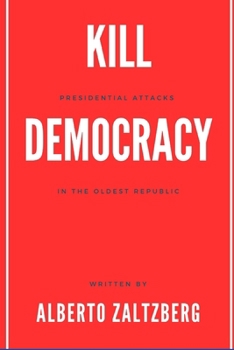
Kill Democracy: presidential attacks in the oldest republic

The inspiration for this book stems from a universal truth: societies thrive when governed by laws that reflect shared ethical principles. The Ten Commandments, given to Moses at Mount Sinai according to the Judeo-Christian tradition, offer a powerful analogy. These precepts-from "You shall not murder" to "You shall not covet"-are not mere religious rules but a foundational code for ordering communities. They forbid chaos (murder, theft, lying) and promote cohesion (honoring parents, respecting one's neighbor). In a society without laws, anarchy reigns; in one with oppressive laws, liberty dies. American democracy, inspired in part by these ethical traditions, found a balance: a government structured with three branches-executive, legislative, judicial-that is self-policing but subordinate to the people through free and periodic voting.
The importance of this structure lies in its ability to channel power without allowing its abuse. The Founding Fathers, like James Madison, understood that government must be strong to protect rights, but limited so as not to stifle them. The separation of powers ensures that no leader becomes a tyrant; federalism distributes regional tensions; and the vote-extended from white property owners in 1789 to all citizens over 18 in 1971-guarantees that the people are the ultimate sovereign. This system, though imperfect, has allowed the United States to navigate crises that destroyed other democracies, such as the Weimar Republic or the Latin American republics of the 20th century. It has survived because, like the Commandments, it balances order with freedom, authority with responsibility.
Democracy, at its core, is the purest expression of human potential. It is not perfect-it has faced slavery, segregation, inequality-but its design allows for correction: amendments, social movements, elections. It is a system that believes in the individual's capacity to decide, grow, and contribute, protected by laws that, like the Commandments, set limits on coexistence. This book sustains a fervent hope: that democracy, when guided by ethical principles and controlled by the people, not only guarantees freedoms but unleashes full human development-intellectual, moral, creative. Every attack described here, from Booth's shooting to the 2024 plots, was an attempt to extinguish that beacon; every survival was a reaffirmation of its light.
Related Subjects
HistoryCustomer Reviews
ThriftBooks ® and the ThriftBooks ® logo are registered trademarks of Thrift Books Global, LLC
