


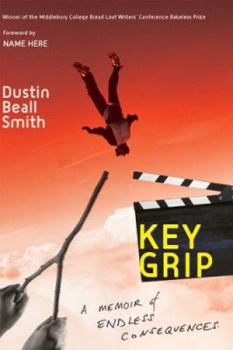
Key Grip: A Memoir of Endless Consequences

Select Format
Select Condition 
Book Overview
A key grip, Dustin Beall Smith explains in this award-winning memoir, is the person on a film set who supervises the rigging of lights, set wall construction, dolly shots, stunt preparation, and more. Smith worked in the film industry throughout the 1970s, '80s, and '90s. For him, "fame by association"--with iconic stars including Sly Stallone, Susan Sarandon, and Robert De Niro--was just one of the seductive drugs fueling his high-octane days on the set. The intertwined stories in Key Grip resurrect memories of how his father's impossibly ordered life became a goad for Smith's own reckless journey to manhood. Its trajectory includes a stint as a pioneering sport-parachuting instructor in the late 1950s--a young man's dream job that taught Smith how to hide sheer animal fear behind male bravado. Much later, as a committed writer and unredeemed seeker in his fifties, Smith lights out cross-country for what turns out to be a brave, existentially failed--and very funny--attempt at a Lakota vision quest. Beautifully told, reminiscent of both Robert Bly and Ian Frazier, Key Grip is a fascinating record of the fault lines of one man's life. Dustin Beall Smith's Key Grip won the 2007 Bakeless Prize for nonfiction, awarded by the Middlebury College Bread Loaf Writers' Conference and judged by Terry Tempest Williams. Smith has lived in New York City for over forty years and teaches writing at Gettysburg College.
Format:Paperback
Language:English
ISBN:054705369X
ISBN13:9780547053691
Release Date:August 2008
Publisher:Mariner Books
Length:176 Pages
Weight:0.50 lbs.
Dimensions:0.4" x 6.3" x 8.2"
Customer Reviews
5 ratings
Gripping
Published by Thriftbooks.com User , 17 years ago
Dustin Beall Smith's first collection is by turns tender and searing, a memoir in linked essays written in blood with razor blades by a man who's life is both a cautionary tale and a triumphant one. Smith's stories take readers through two failed marriages, buckets of booze, dicey encounters with film stars and producers, Indian sweat lodges, and snapping turtles. When living on the edge doesn't satisfy Smith's peak-experience addiction, he finds perfectly good airplanes to jump off of. I'm being facetious, but not purely. The metaphors supplied by skydiving and sweat lodges work splendidly here. More than anything else what comes through these pages is a portrait of a man searching for his soul in all the wrong--or anyway the least obvious--places: on the wings of airplanes and at the bottoms of bottles. The pages of this slim volume hold more pain and loss than those of many a fat book James Frey's faux memoir springs to mind). But they also hold heaps of redemption, for as the writing aptly demonstrates, Smith has emerged from his losses with a ruthless eye for self-scrutiny and an analytic grasp that would make Freud blush. The cautionary tale is that of a reckless, thrill-seeking boozer; the triumph is that of a brilliant writer. KEY GRIP gripped me from page one and wouldn't let go.
Crying for a Dream
Published by Thriftbooks.com User , 18 years ago
Dustin Beale Smith's stunning new book of essays, Key Grip, will cut you, perhaps deeply, and do it while you are enjoying yourself, so thoroughly immersed in Smith's magnificently simple, straightforward prose, that you won't know what hit you. You may feel, in the words of the "young director, James Mangold" asking "Sly Stallone" to tone down his "sadness" in the early scenes of Cop Land (shot in 1997, Dusty Smith, Dolly Grip) " . . . lugubrious." " . . . what you're really feeling right now is . . . lugubrious." (p. 102) Say you're a writer. Unless you're a writer who really has made it, you may indeed feel a bit gloomy from time to time, struggling as you do to find an audience of more than one or two lovers and friends, especially if you've settled for the hollow gratification of the barroom rake who wants to live the writer's life, but never quite gets an actual career off the ground. In that case, Dusty may be too honest for you. The prospect of having someone truly eminent, like Annie Leibovitz, the photographer, come rushing up to you in your mid-fifties to gush about how much your work has meant to her, and you let her go on, knowing " . . . she'd confused you with someone who actually was talented and famous," may force you to ask, "(t)o what end, and for what purpose, have you lived this preposterous, imposterish life?" (p. 154) "To what end . . .?" Whatever answer you give yourself--reassuring or comfortless--you'll end up doing it with a smile when you get to the end of this book. No matter how badly you think you've failed to live up to whatever vision you started out with when you were young, you'll see that there is hope for you yet. Much hope, because in the end you may find that "(f)or an instant--and an instant is all you need--you know what you are going to be when you grow up." (p. 155) In "Starting from the Bottom Again," the first in Smith's series of loosely connected essays, he leaves his home in New York City and his work in the film business with an enigmatic Lokota Souix from the Pine Ridge Reservation in South Dakota, whom he calls "Arturo Has No Past," and arrives four days later at a ". . . a hand-lettered sign that read(s) END OF THE ROAD," He is fifty-seven years old, and at the END OF THE ROAD his life takes an irreversible turn. This is the home of "Mike Little Boy," Arturo's father, a ". . . toothless, weather-beaten Indian . . ." (p. 20), who is also a Medicine Man, where Smith, with no special preparation or planning, has come for ". . . a prayer ritual called hanblecheya, which translates as `crying for a dream' and is popularly known as a vision quest." (p. 3) The spirit of Dusty's story might be summed up by Mike Little Boy's warning. Dusty is skeptical because of the dilapidated condition of the prefab house and the junk-strewn yard and because Mike will only agree to let him do part of the hanblecheya. Smith expects to "go up the hill" for the entire four-day ritual after coming
Couldn't Put It Down
Published by Thriftbooks.com User , 18 years ago
It's a rare gift to write an essay collection that keeps you reading from the first page to the last. Dustin Beall Smith has that gift. This is not a book about the film industry (PUBLISHERS WEEKLY missed the point!), rather it is about the thing we'd rather not discuss in American culture, failure. In thirteen essays that move backward in time, Smith looks at failure from every possible angle--in work, family, and spiritual questing--and, instead of instilling doom, he uses humor, honesty, and humility to prove that redemption is possible should one decide to tackle failure head-on. Smith's narratives are edgy, insightful, and focused. He takes you from the sublime (the thin separation between this world and the world to come) to the tragic (the killing of a turtle) to the ridiculous (standing drunk and naked outside a locked hotel room door in Georgia) without missing a beat. This is a spot-on exposé, not of movie stars and their ilk, but of what James Baldwin called "the price of the ticket," where the ticket is what it means to be a man in America. Buy and read this book: you won't regret it for a second.
The Struggle To Discover The Authentic Self
Published by Thriftbooks.com User , 18 years ago
Dustin Beall Smith pulls us down to the briny deep of fear, uncertainty and doubt about our personal authenticity. From the beginning to the end, he sets off a profound introspection about the basic premises that underlie the formation of identity. Smith forces us to ask: "Do I know who I am and what I believe? Is it a false or manufactured self? How do I know it's authentic? Have I really experienced any authentic rites of passage that have shaped my identity? Have I lived a life of success by association, not of my own making? What have I DONE of any real consequence? Unsparingly, Smith confronts us with his own most excruciatingly painful struggles---plunging us into a self-examination of our own deepest self-deceptions---very scary stuff. We are forced to ask ourselves: How am I to actually ENGAGE in life? By one well-chosen life pursuit, all the way through? By a variety of pursuits, until I find the ONE that liberates my authentic self? Or a series of well-chosen pursuits valued in and of themselves as a more complete reflection of my authentic self? And, what, now, if I have never actually engaged in a real life pursuit? Incredibly, Smith nurses us through this nightmarish soul-searching with fond, tender affection, mixed with world-weary good humor. If you follow him down to the darkest depths of KEY GRIP, you may discover a rare form of emancipation.
Wonderful writing
Published by Thriftbooks.com User , 18 years ago
Dustin Smith is one of the best writers around. Who hasn't gone to the bookstore, plunked down money, cracked open the books you bought, and found most of them weren't worth reading? You could wade through piles of books and not find a better one to read than Key Grip. Entertaining, spiritual, wickedly down to earth, with to-the-bone insights. I hope this book gets the attention it deserves. I also wish Dustin Smith a long and successful writing career. Key Grip is terrific.
Copyright © 2026 Thriftbooks.com
Terms of Use | Privacy Policy | Do Not Sell/Share My Personal Information | Cookie Notice | Cookie Preferences | Accessibility Statement
ThriftBooks ® and the ThriftBooks ® logo are registered trademarks of Thrift Books Global, LLC
ThriftBooks ® and the ThriftBooks ® logo are registered trademarks of Thrift Books Global, LLC
