


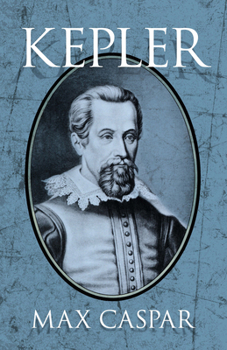
Kepler

Select Format
Select Condition 
Book Overview
A towering figure in intellectual history and one of the fathers of modern astronomy, the great mathematician Johannes Kepler (1571-1630) is best known for his discovery of the three laws of planetary motion, which paved the way for a dynamic explanation of the heavenly phenomena. At a time when the Ptolemaic view still prevailed in official circles, Kepler undertook to prove the truth of the Copernican world view and through exceptional perseverance and force of intellect achieved that goal. His epochal intellectual feats are completely and thoroughly described in this splendid work, considered the definitive biography of Kepler. Drawing on a wealth of primary sources, the author presents a fascinating and erudite picture of Kepler's scientific accomplishments, his public life (work with Tycho Brahe, the Danish astronomer; mathematical appointments at Graz, Prague, and Linz; pioneering work with calculus and optics, and more) and his personal life: childhood and youth, financial situation, his mother's trial as a witch, his own lifelong fear of religious persecution, his difficulties in choosing one of eleven possible young women as his second wife, and more, through his last years in Ulm and death in Regensburg. Until his death in 1956, Professor Max Caspar was the world's foremost Kepler scholar. He had spent over two-thirds of his life assembling, cataloging, describing, analyzing, and editing Kepler's works. To this biography he brought tremendous learning and passionate enthusiasm for his subject, creating an unsurpassed resource on the life and work of one of history's greatest scientific minds. Originally published in German and superbly translated into English by C. Doris Hellman, Kepler will fascinate scholars and general readers alike.
Format:Paperback
Language:English
ISBN:0486676056
ISBN13:9780486676050
Release Date:September 1993
Publisher:Dover Publications
Length:464 Pages
Weight:1.06 lbs.
Dimensions:0.9" x 5.3" x 8.5"
Customer Reviews
5 ratings
Quite good
Published by Thriftbooks.com User , 17 years ago
This biography is fine, but it cannot be recommended above Koestler's biography, which is more beautifully written and, I think, not as scholarly inferior as some people say. The discrepancy in terms of style seems to be due in part to this translation being rather clumsy (although I have not compared it with the German original). Let us consider some comparisons between this book and Koestler's in this regard. Where Koestler has (quoting Kepler) "geometry was implanted into man ... and not merely conveyed to his mind through the eyes" (p. 262), Caspar reads: "geometry ... has been transferred to man ... [and] not received inside through the eyes" (p. 381). Or (again quoting Kepler): "be greeted, double knob, children of Mars" (Caspar, p. 201) versus "hail, burning twin, offspring of Mars" (Koestler, p. 377). Now it may be said that Koestler operates with a poetic licence (which is probably true in the latter case, but often not), but so should this book, which is also a popular account with no footnotes or references. No footnotes or references, that is, except those added by the translator/editor. And in these she reveals her appalling lack of taste. She is extremely inconsistent in what gets a footnote and what does not, which seems to be due, firstly, to the fact that she does not know the material very well, and, secondly, to the fact that she shamelessly wants to refer to her own work whenever possible. And she completely destroys the flair of Caspar's stylish sentence "[Kepler] did not start with doubt, as another soon did, but with an unquestioned faith in ratio" (p. 377) by inserting a dimwitted attempt at a joke: "Ed. note: Doubtless, reference here is to Descartes (1596-1650)." Quibbles aside, this is of course still a very interesting book. Here are some of my favourite themes: "Aesthetic-artistic consideration of the universe" (p. 382). "I consider it my duty and task ... to advocate ... what I ... have recognized as true and whose beauty fills me with unbelievable rapture on contemplation." (Kepler, p. 298). "I may say with truth that whenever I consider in my thoughts the beautiful order, how one thing issues out of and is derived from another, then it is as though I had read a divine text, written onto the world itself ... saying: Man, stretch thy reason hither, so that thou mayest comprehend these things" (p. 152). Mathematics a means to this end. "Kepler consciously renounced [Archimedean] rigor and wanted to take over from Archimedes only so much as 'is sufficient for the pleasure of the lovers of geometry.'" (p. 234). "Don't sentence me completely to the treadmill of mathematical calculations and leave me time for philosophical speculations, which are my sole delight. Each one has his own particular pleasure, one the tables and nativities, I the flower of astronomy, the artistic structure of the motions." (Kepler, p. 308). Man's cognitive abilities designed for this purpose. "[T]he world partakes of quantity and the mind o
The Complete Story of Johannes Kepler the Heretic Astronomer
Published by Thriftbooks.com User , 18 years ago
This biography is simply the best on the life and trials of Johannes Kepler.Anyone,who is exploring the field of astronomy,should invest their time in reading this great book.It's the fascinating story of a genius scientist having to deal with the heretical zeitgeist and relentless religious persecution of his times.Ironically,more from his own protestant leadership rather than the catholic church.Kepler was like the modern Socrates during this epoch leading to the Age of Reason. Kepler supported the Greek Copernican world model,which was in direct oppossion to the teachings of all christian-jewish European schools.Kepler did not want to 'drag the owls of knowledge to Athens',yet to bring their greek pagan wisdom to the heart of the European centers of learning.This is just an excellent book for any astute historian with a budding interest in the laws of the stars above us.
If you dig Kepler, you'll love this book
Published by Thriftbooks.com User , 22 years ago
Like the other reviewers have said, this book is simply the best combination of an account of Kepler's life, theories, and works.
Widely considered Kepler's definitive biography
Published by Thriftbooks.com User , 25 years ago
Although written in 1948, Caspar's biography is today still the most comprehensive attempt to portray the person of Kepler in a unified manner. This work reflects Caspar's lifetime of work dedicated to Kepler's many publications, manuscripts, and correspondences, and, thanks to additional citations made by editor Owen Gingerich, the reader may now find where nearly all of these passages derive from. Both the common reader and serious student may benefit from this book, for it combines Kepler's scientific studies with the deeply personal conflicts of an early modern genius. Caspar's biography is fundamental not only for studies made on Kepler, but also for the Scientific Revolution in general.
If you are at all serious......
Published by Thriftbooks.com User , 25 years ago
....about Kepler, you must have this book. Period. By the way, Arthur Koestler's Sleepwalkers (and the Kepler chapters which were published under the title The Watershed) rely heavily on Caspar's book.
Copyright © 2026 Thriftbooks.com Terms of Use
| Privacy Policy | Do Not
Sell/Share My Personal Information | Cookie Policy | Cookie Preferences | Accessibility Statement
ThriftBooks® and the ThriftBooks® logo are registered trademarks of Thrift Books Global, LLC
ThriftBooks® and the ThriftBooks® logo are registered trademarks of Thrift Books Global, LLC
