


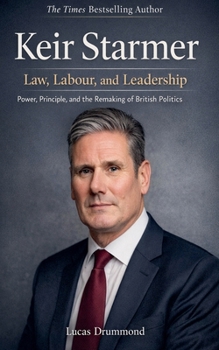
Keir Starmer Law, Labour, and Leadership

Keir Starmer: Law, Labour, and Leadership is not a conventional political biography. It is a serious, compelling portrait of power, responsibility, and restraint in an age dominated by noise, spectacle, and division.
At a time when politics is often reduced to personality and performance, this book tells a different story: the rise of a leader shaped not by slogans, but by law; not by outrage, but by judgement. From his early career as a human rights lawyer to his tenure as Director of Public Prosecutions, and from the turmoil of Brexit to the rebuilding of the Labour Party, this book traces the formation of a leadership style defined by seriousness, discipline, and moral responsibility.
Keir Starmer's journey is one of institutions under pressure and standards under threat. As a lawyer, he defended the rule of law when it was unpopular to do so. As DPP, he carried the weight of decisions that affected lives, liberty, and public trust. And as Labour leader, he inherited a party fractured by defeat, damaged by scandal, and mistrusted by the electorate. What followed was not reinvention through rhetoric, but reconstruction through reform.
This book explores how Starmer confronted antisemitism within his party, redrew Labour's moral compass, and insisted on standards even when doing so provoked backlash. It examines his resistance to populism, his uneasy relationship with charisma, and his belief that credibility is earned slowly through consistency rather than seized through performance. In a political culture addicted to certainty, Starmer chose honesty about limits. In an era of constant reaction, he chose preparation.
More than a biography, Keir Starmer: Law, Labour, and Leadership is a meditation on modern governance. It asks what leadership looks like when institutions are fragile, trust is exhausted, and democracy itself feels strained. It challenges the assumption that loudness equals strength, and argues instead for a politics rooted in responsibility, legality, and restraint.
Written with clarity and authority, this book situates Starmer within the wider crises of British politics: Brexit, declining trust, cultural division, and the erosion of public standards. It shows how his legal background continues to shape his political instincts, from his approach to policy and reform to his understanding of patriotism, power, and accountability.
For readers seeking insight rather than hype, substance rather than spin, this is an essential account of one of the most consequential political figures of his generation. Whether admired or questioned, Keir Starmer represents a serious answer to an unserious age.
This is a book about leadership without illusion, power without bravado, and the difficult work of rebuilding trust when it has been broken. It is for anyone who wants to understand not just who Keir Starmer is-but what kind of politics might come next.
Customer Reviews
ThriftBooks ® and the ThriftBooks ® logo are registered trademarks of Thrift Books Global, LLC
